 Locations
FMS Dental founded
FMS Dental began operations in Hyderabad, building a foundation in comprehensive dental care.
Zygomatic implants bypass the upper jaw entirely, anchoring in the cheekbone instead. If other clinics have turned you away due to bone loss — this may be the answer they didn't offer you.
Zygomatic Since
Protocols
Grafts Required
GCR Ranked
Zygomatic implants are 30–55mm titanium implants anchored in the cheekbone (zygoma) instead of the upper jaw. They are the definitive solution for patients with severe or complete upper jaw bone loss who cannot receive conventional implants. FMS Dental Hyderabad has performed zygomatic implants since 2011 under Senior Implantologist Dr. Shailaja Reddy (Nobel Biocare zygomatic certified) and Oral & Maxillofacial Surgeon Dr. Dushyanth Paul. All four protocols are available: classical intra-sinus, extra-sinus, pterygoid combination, and quad zygoma. No bone graft is ever required. Fixed teeth are placed the same day as surgery. Cost: starting from Rs. 6,00,000/arch NABH accredited. Ranked #1 India, #5 World by GCR .
Cheekbone — not the jaw
2011
Never required
₹6,00,000
Multiple protocols available
When the upper jaw has lost too much bone for conventional implants, the question isn't "is it possible?" — it's "are we anchoring in the right structure?"
Zygomatic implants (30–55mm titanium fixtures) bypass the resorbed upper jaw entirely and anchor directly into the zygomatic bone — the cheekbone — a dense, cortical structure that does not resorb with age or tooth loss. Developed by Nobel Biocare in collaboration with Professor Per-Ingvar Brånemark in 1998, the concept was straightforward: if the jaw has lost its bone, use a different bone entirely. The cheekbone is always present, always dense, and anatomically positioned to support a full upper arch of fixed teeth when the correct implant geometry is applied.
For patients who have been told "implants are impossible" due to upper jaw bone loss, this is the technical reason that assessment may be wrong — or at least incomplete. That conclusion is typically based on a standard panoramic X-ray, which maps the jaw bone but tells us nothing specific about cheekbone dimensions at the 30–55mm depths zygomatic implants occupy. A full facial CBCT scan — a different, three-dimensional scan than the standard jaw CBCT used for conventional implants — is what actually answers the question. Until that scan has been done by a surgeon trained in zygomatic protocols, "impossible" is an assessment without the data to support it.
The cheekbone does not resorb because it carries no dental load — it isn't connected to the teeth the way the alveolar ridge is, and it isn't affected by the same biological processes that cause the upper jaw to shrink over years without tooth roots or implants to stimulate it. This makes it a uniquely reliable anchor: unlike grafted bone, which is sourced externally and integrates with variable predictability, the cheekbone is living cortical bone that has been there the patient's entire life.
Three times longer than a conventional dental implant, spanning from the upper jaw arch all the way to the cheekbone at depths a standard implant never approaches.
The cheekbone is used as-is. No graft is harvested, placed, or waited upon — eliminating 6–12 months of graft healing from the treatment timeline entirely.
A provisional fixed bridge is attached to the zygomatic implants on the day of surgery, within hours of the procedure — not days, not weeks.
The critical distinction: zygomatic implants are not a "last resort" after conventional implants have failed. For patients with severe upper jaw bone loss, they are the correct first-choice protocol — delivering outcomes that the bone graft route, even when successful, takes more than a year longer to achieve.
FMS Dental has performed zygomatic implants since 2011 — built on a foundation in implant dentistry that began more than a decade earlier.
FMS Dental began operations in Hyderabad, building a foundation in comprehensive dental care.
The start of an implantology practice that now spans over 25 years and 25,000+ implants placed.
Precision upper-jaw augmentation, building the anatomical expertise that directly underpins zygomatic surgery.
Among Hyderabad's earliest adopters of immediate-loading full-arch implants — the clinical stepping stone to zygomatic.
Dr. Shailaja Reddy (Nobel Biocare zygomatic certified) and Dr. Dushyanth Paul began performing all four zygomatic protocols, including the first quad zygoma cases in the region.
Post-mucormycosis reconstruction, post-cancer rehabilitation, quad zygoma for zero-bone cases — some of the most complex zygomatic surgery performed in India.
Zygomatic surgery involves anatomy that conventional implantology rarely encounters — the infraorbital nerve, the orbital rim, the sinus wall, and in quad zygoma, the skull-base pterygoid process. The surgeon's experience with zygomatic-specific anatomy — not general implant experience — is what determines surgical safety and outcome. FMS Dental's team has been navigating this anatomy since 2011. That track record is not replicated by a clinic that recently added zygomatic implants to its service menu. Since 2011, Dr. Shailaja Reddy and Dr. Dushyanth Paul have led the multidisciplinary team responsible for every zygomatic implant case at FMS Dental. Their expertise extends beyond clinical practice, with both doctors actively teaching and mentoring students in zygomatic implant protocols since 2011.
FMS Dental is one of very few centres in Hyderabad India offering multiple protocols. The protocol selected is determined entirely by your full facial CBCT scan anatomy — not preference, not cost.
The original Nobel Biocare / Brånemark technique, with over 25 years of published clinical evidence. The zygomatic implant passes through the maxillary sinus cavity on its path from the upper jaw ridge to the cheekbone. Highly documented, extensively validated, and still the first-choice protocol for patients with partial maxillary resorption who retain residual sinus floor bone.
The zygomatic implant is placed entirely outside the maxillary sinus — running along the outer lateral surface of the maxilla directly to the cheekbone, without entering the sinus cavity at all. This significantly reduces the risk of sinus complications including sinusitis and sinus membrane perforation, which are the most common complications associated with the classical intra-sinus approach.
Four zygomatic implants — two per side, anchored bilaterally in both cheekbones — with no standard jaw implants used at all. The entire upper arch rests on cheekbone anchorage. Reserved for complete upper jaw bone absence: post-mucormycosis jaw resection, post-head-and-neck cancer surgery, or extreme long-term resorption where no residual maxillary bone is viable for any implant type.
For patients where zygomatic cheekbone anchorage alone cannot complete the posterior arch — typically because the posterior upper jaw has collapsed entirely, leaving no support point behind the zygomatic implants. Additional implants are placed into the pterygoid process of the sphenoid bone at the skull base, providing posterior support without any grafting or sinus intervention.
Protocol selection is determined by imaging, not conversation. A full facial CBCT — not a standard jaw CBCT — maps cheekbone dimensions at 30–55mm depth, sinus anatomy, infraorbital nerve position, and residual maxillary bone. Dr. Shailaja Reddy reviews this data with Dr. Dushyanth Paul before any recommendation is made.
Specific, verifiable reasons that matter specifically for zygomatic surgery — not general dental marketing.
A clinic that only performs classical intra-sinus cannot recommend extra-sinus for a patient who would benefit from it. Access to all four means the recommendation is anatomically driven, not capability-limited.
Zygomatic planning requires cheekbone dimensions at depths a jaw CBCT doesn't reach. FMS Dental uses a full facial CBCT for every zygomatic case — the scan that actually answers whether your cheekbone can support the procedure.
Dr. Shailaja Reddy and Dr. Dushyanth Paul, together with a highly experienced multidisciplinary team, successfully performs every zygomatic implant case at FMS Dental since 2011. In addition to their clinical expertise, they have been training dental students in zygomatic implant protocols since 2011.
While implants provide the foundation, the final bridge defines the outcome. Dr. Kavya and Dr. P. Parthasaradhi Reddy oversee the design and placement of every definitive prosthesis, ensuring exceptional function, aesthetics and patient satisfaction from the very beginning.
FMS Dental has successfully treated some of the most complex zygomatic cases in Hyderabad India — patients with partial jaw resection following mucormycosis or head-and-neck cancer. These cases require quad zygoma or pterygoid combination protocols that few centres in the region offer.
Zygomatic surgery — particularly quad zygoma at 5–7 hours — requires GA, not just IV sedation. FMS Dental is a NABH - accredited hospital with full anaesthesia infrastructure, anaesthesiologist on staff, and post-operative monitoring. Not every dental clinic can offer this.
The same lifetime warranty that applies to conventional implants at FMS Dental applies to zygomatic and pterygoid implants — documented in writing, subject to annual review. For a procedure this significant, that documentation matters.
The single most common reason patients arrive at FMS Dental for zygomatic implants: they were told elsewhere that nothing could be done.
Long-term tooth loss, years of denture wear, or any condition that has significantly resorbed the upper alveolar ridge to the point where conventional implants cannot achieve primary stability.
If the assessment was based on a panoramic X-ray without a full facial CBCT, it may have been based on incomplete data. "Impossible" without a full facial CBCT is a statement without the evidence.
Patients for whom bone grafts have already failed or been rejected — zygomatic implants require no graft, so failed grafting history does not affect candidacy.
Patients with partial jaw resection following mucormycosis, head-and-neck cancer, or other jaw surgery are among the specific cases quad zygoma or pterygoid combination protocols address.
Years of denture wearing causes progressive jaw bone resorption without root stimulation. Many long-term denture wearers no longer have sufficient jaw bone for any conventional implant approach.
Well-controlled diabetes is acceptable — FMS Dental coordinates with your physician to bring HbA1c to a safe level before scheduling. Uncontrolled significantly elevates infection and osseointegration failure risk.
Smoking constricts cheekbone blood supply and significantly elevates zygomatic failure risk — more than for conventional implants, because the implant engages a longer bone column. Cessation is strongly recommended and discussed at assessment.
Minimum 12 months post-radiation required, with oncologist clearance. Hyperbaric oxygen therapy may be indicated. FMS Dental coordinates with the treating oncology team.
Reviewed case by case depending on drug type, dosage, and duration. Assessed jointly with the prescribing physician before any surgical planning.
Second opinions welcome and strongly encouraged. FMS Dental regularly evaluates patients who have been refused zygomatic implants elsewhere. Bring any existing imaging. A full facial CBCT assessment is the starting point for an honest answer.
A standard jaw CBCT — the 3D imaging used for conventional implant planning — maps the alveolar ridge, the inferior alveolar nerve, and the immediate sinus floor. It is designed for jaw anatomy and covers a vertical depth of roughly 8–16mm from the ridge, which is all a standard implant needs.
Zygomatic implants are fundamentally different. Measuring 30–55 mm in length, they extend far beyond the jawbone and anchor into the zygomatic (cheek) bone. Accurate planning therefore requires visualization of the entire maxillofacial skeleton, including the sinus, orbit, zygoma, and surrounding facial structures—areas that are not adequately captured by conventional jaw-focused scans.
This is why FMS International Dental Center utilizes the Carestream CS 9600 3D CBCT system with a 16×17 flat-panel detector. Capable of capturing full-skull, high-resolution 3D images with minimal radiation exposure, it provides comprehensive visualization of the teeth, jaws, cheekbones, sinuses, and facial anatomy. This level of imaging is essential for precise zygomatic implant planning, helping the surgical team assess implant trajectories, anatomical variations, and critical structures with confidence before treatment begins.
Planning a zygomatic implant without full-skull CBCT imaging is the equivalent of designing a structural foundation using a survey that stops at the surface.
A full facial CBCT produces a volumetric dataset covering the entire cranio-facial anatomy relevant to zygomatic surgery: cheekbone height, width, and depth at 30–55mm; the three-dimensional course of the infraorbital nerve; the orbital rim; sinus wall thickness; and the pterygoid process anatomy for combination cases. This dataset is what makes digital surgical planning possible — allowing Dr. Shailaja Reddy and Dr. Dushyanth Paul to position every implant virtually before the first incision, fabricate a custom surgical guide, and execute the case with the precision that cheekbone surgery requires.
At FMS Dental, every zygomatic assessment begins with a full facial CBCT — not a standard jaw CBCT, not a panoramic X-ray, and not a referral for imaging elsewhere. The scan is interpreted directly by the surgical team, shown to the patient on-screen, and forms the basis of both the protocol recommendation and the surgical plan. It takes 30 minutes to acquire and answers definitively whether zygomatic implants are viable for your specific cheekbone anatomy.
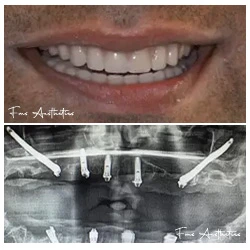
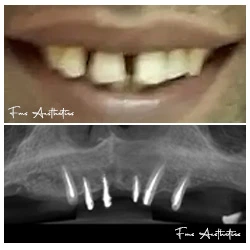
Bilateral zygoma · 10-day protocol · Saving Rs. 15+ lakhs vs UK
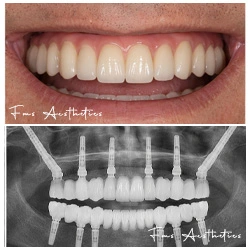
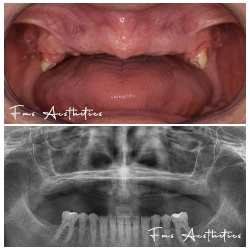
Extra-sinus protocol · Zero upper jaw bone · 58 yrs · Hyderabad
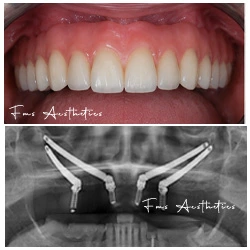
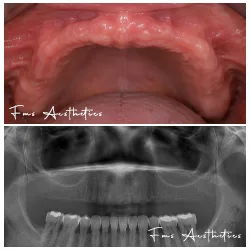
4 zygomatic implants · Complete maxillary loss · 62 yrs
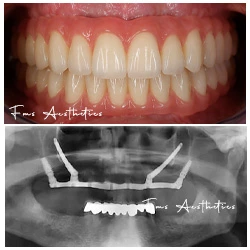
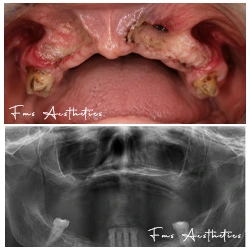
Zygoma + pterygoid · Jaw reconstruction · 55 yrs
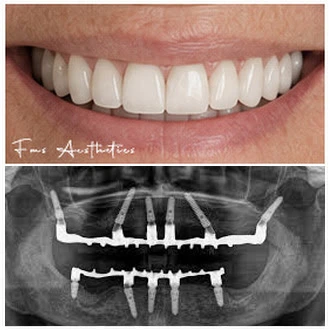
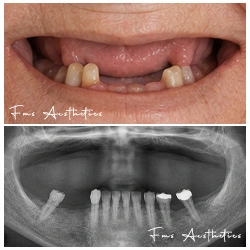
Bilateral zygoma · Upper arch · 67 yrs · 15 years of dentures
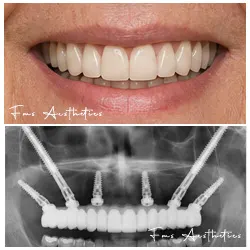
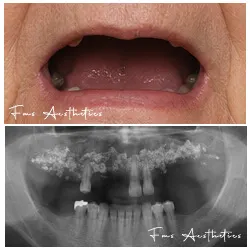
Extra-sinus zygoma · Failed graft elsewhere · 61 yrs
The price driver is the implant system and protocol complexity. Here is exactly what each tier costs and what the difference delivers clinically.
Zygomatic implants at FMS Dental start from Rs. 6,00,000 per arch using Nobel Biocare Zygomatic (the original system, with 25+ years of published clinical evidence). Quad zygoma: Rs. 7,00,000+. Every figure includes full facial CBCT, Nobel Biocare zygomatic implants, same-day provisional fixed bridge, in-house zirconia prosthetics, all monitoring visits and a lifetime warranty.
Nobel Biocare's zygomatic system carries the deepest published evidence base of any zygomatic implant — 25+ years of peer-reviewed data, TiUnite surface chemistry for rapid cortical bone integration, and the original protocol developed with Professor Brånemark. Primary recommendation for complex, high-risk, or post-mucormycosis/post-cancer cases.
HDFC, ICICI, SBI, Axis, Kotak for qualifying amounts
USD, GBP, EUR, AED accepted via wire or card
For patients with severe upper jaw bone loss, both paths lead to fixed teeth. Here is an honest account of what each actually involves.
| Factor | Zygomatic Implants ✓ | Bone Graft + Conventional |
|---|---|---|
| Bone graft required | Never | Yes — 1–3 separate procedures |
| Same-day fixed teeth | Yes — day of surgery | No — wait 6–12 months post-graft |
| Total treatment time | 3–5 months | 12–18 months |
| Number of surgeries | 1 main surgery | 2–4 separate surgeries |
| Sinus lift required | No | Usually yes |
| Graft failure risk | Not applicable | 15–25% graft failure rate reported |
| Viable for zero-bone cases | Yes — quad zygoma | No viable path |