ALL-ON-4 · PIONEERS SINCE 2008

All-on-4 Dental Implants in Hyderabad – Fixed Teeth in a Day

Four implants — two placed straight, two precisely tilted — replace an entire arch without a bone graft in most cases. FMS Dental has practised this exact protocol for over eighteen years.This is everything you need to know, explained properly.

No graft in most cases Same-day fixed teeth NABH accredited #1 India · #5 World (GCR) International Dental Clinic of the Year IMTJ Award Best Dental Hospital — South India Times Healthcare Survey · 9 Consecutive Years

2008

All-on-4 Since

25K+

Implants Placed

98.6%

Success Rate

₹4.0L

Starting Price

The Engineering Behind It

Four Implants. One Geometry.

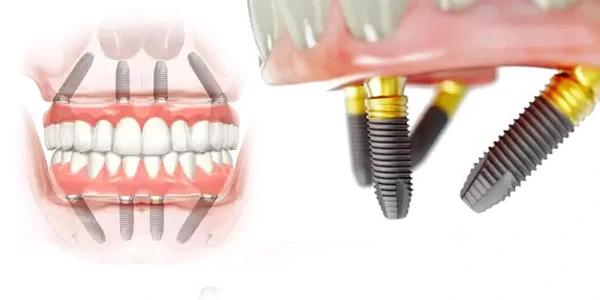
FIXED BRIDGE
TILTED ~30–45°
TILTED ~30–45°
Straight — anterior
Tilted — posterior
Implant Systems We Use
Nobel Biocare Straumann Osstem Alpha-Bio
WHAT IS ALL-ON-4 DENTAL IMPLANT PROTOCALL

All-on-4 at FMS Dental Hyderabad India

All-on-4 is an immediate-loading full-arch implant protocol using 4 titanium implants per jaw 2 placed axially at the front, 2 tilted 30–45° at the rear — supporting a fixed provisional bridge delivered the same day as surgery. FMS Dental Hyderabad India introduced All-on-4 in 2008, among the earliest centres in India to adopt the protocol, practised continuously since under Senior Implantologist Dr. Shailaja Reddy (26+ years). Mid-tier implants (Osstem, Alpha-Bio) start from Rs. 4,00,000/jaw; premium implants (Nobel Biocare, Straumann) start from Rs. 5,00,000/jaw. NABH accredited, rated #1 in India and #5 in the World by Global Clinic Rating (GCR)..


Implants

4/jaw

2 tilted long implants

Since

2008

All-on-4 Protocol

Mid-Tier From

₹4,00,000

Osstem · Alpha-Bio

Premium From

₹5,00,000

Nobel Biocare · Straumann

Healing

4–6 Months

Average Integration

Ranking

#1 India

#5 World

Our History

Why FMS Dental is a Pioneer in Full Arch Implant Dentistry in Hyderabad, India

All-on-4 is still a young protocol globally. FMS Dental, renowned as best dental implant clinic in India, has practised it for more than eighteen years — built on a far longer foundation in implant dentistry

1993

FMS Dental founded

The clinic that would become FMS International Dental Center began operations in Hyderabad.

1999

First dental implant placed

The start of an implantology practice that now spans nearly three decades of continuous case experience.

2005

Sinus-lift bone augmentation mastered

Enabling implant placement in upper-jaw cases where bone height alone would have ruled it out.

2008

All-on-4 introduced at FMS Dental

Among the earliest centres in India to adopt the protocol following its international clinical validation.

2011

All-on-4 with Zygoma implants introduced at FMS Dental

One of the only centre in India at that time to introduce Zygomatic implant protocol in combination with All-on-4.

Today

25,000+ implants, 13 locations

All-on-4 surgery remains centralised at the Jubilee Hills flagship for surgical consistency.

What "pioneer" means here

FMS Dental didn't invent All-on-4 — the protocol originated with the Maló Clinic and Nobel Biocare internationally. It means FMS Dental was among the first clinics in Hyderabad India to bring it into routine practice in 2008, refined through close to two decades of continuous cases since.

Why that history matters

Immediate-loading decisions — the insertion-torque judgment calls made mid-surgery — benefit directly from volume and repetition. A surgeon who has made that call thousands of times brings a different level of pattern recognition than one on their first hundred cases. Natural looking Prosthodontic options from senior Prosthodontists & top cosmetic dentists with an in-house lab and master technicians.
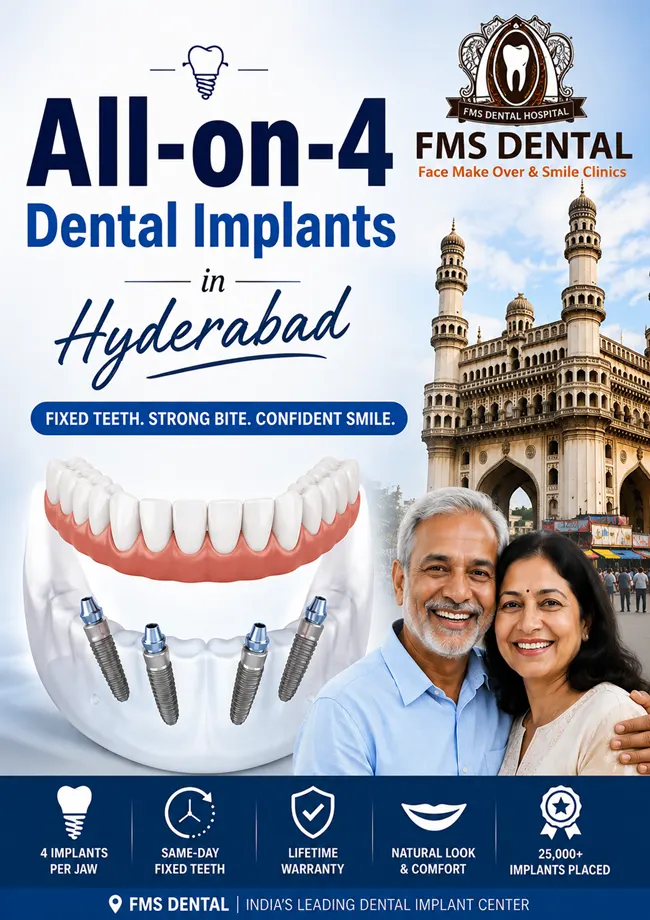
ALL-ON-4 Dental Implant in Hyderabad
The Mechanics

Why Tilting Two Implants Changes Everything

All-on-4 isn't "All-on-6 minus two." It's a different geometric solution — and the tilt is the entire point, not a compromise.

All-on-4 traces back to the Maló Clinic protocol, developed in the late 1990s and refined from earlier Branemark immediate-function research. Bone directly above the maxillary sinus or in front of the mandibular nerve canal is often too thin for a straight implant. Tilting the two posterior implants 30 to 45 degrees reaches that area of the bone and also without surgically altering the sinus or risking the nerve.

Before All-on-4, a patient with this kind of bone loss had essentially two options: a bone graft and a long wait, or a denture. Neither was a true fix. The graft added months — sometimes close to a year — before implants could even be placed, and grafted bone doesn't always integrate as predictably as the patient's own. A denture solved nothing structurally; it simply sat on top of a jaw that kept shrinking underneath it year after year. All-on-4 exists because someone asked a more precise engineering question: instead of building bone where there isn't any, can the implant simply be angled towards the bone that's already there? Worked out through cadaver and clinical studies in the late 1990s, the answer was yes — provided the angle, the spacing between implants, and the rigidity of the cross-arch connection were all engineered correctly together. Get any one of those three wrong and the structure fails under normal biting force within a few years. Get all three right, and it can carry full function from the very first day.

01

Avoids anatomy, not just bone loss

Tilting the posterior implant keeps it anterior to the sinus wall, or forward of the mental nerve's exit point — frequently avoiding a sinus lift or nerve repositioning entirely.

02

Shortens the cantilever

The unsupported bridge length behind the last implant is where bending force concentrates. The tilt shortens this arm, reducing leverage on the rear implants.

03

More bone contact, same length

A tilted implant engages more linear bone than the same implant placed vertically — useful where vertical bone height is limited.

04

Working with the Senior Prosthodontists

A restored arch is only as good as the prosthetic it carries; Dr. Kavya and Dr. P. Parthasaradhi Reddy design and fit every final prosthesis to function precisely and look natural from day one, for perfect replacement.

05

Four points, spread wide

Maximised "anteroposterior spread" reduces rocking forces on the bridge — what makes immediate loading viable at all.

06

Why not simply use longer implants?

A longer vertical implant sounds like the simpler fix, but it has nowhere to go once it reaches the sinus floor or the nerve canal — length can't solve an anatomical wall. Tilting moves around the obstacle instead of pushing towards it, which is the actual engineering insight behind the whole protocol.

07

Why 30–45°, specifically

Below roughly 30°, the implant doesn't clear the sinus or nerve with reliable safety margin. Beyond about 45°, the angle starts working against the implant — bite force is transmitted less efficiently along its length, and the prosthetic connection becomes harder to seat accurately. That range is the engineering balance point between the two failure modes.
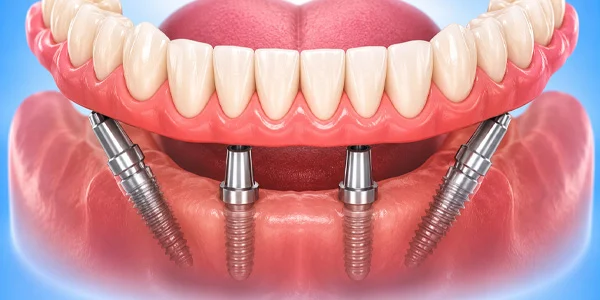
Tilting Two Implants

The consequence for you

Because the posterior implants reach bone that's still there — not bone already resorbed — most patients with moderate bone loss don't need a graft before surgery.

Immediate Function

Is it possible to deliver "Teeth in a Day" with ALL on 4 Dental Implants

Same-day loading isn't a promise — it's a mechanical threshold measured during surgery, implant by implant.

Every implant is torque-tested at placement… resistance measured in Newton-centimetres (Ncm), a direct indicator of how tightly the implant grips bone before healing begins. At FMS Dental, the threshold for same-day loading is 35 Ncm or above across all four implants. The four implants are then splinted together through one rigid prosthesis, distributing bite forces across the whole structure, the way four table legs share a load one leg alone couldn't. This number matters because it stands in for something unmeasurable: how the implant will behave under chewing forces while osseointegration is still underway. A low torque reading means the implant sits in softer bone, with more microscopic movement possible at the bone-implant interface. Too much movement, applied too early, prevents bone cells from fully bonding to the titanium, the implant heals into a fibrous, non-bonded state that functions poorly and fails early. Thirty-five Ncm is the point at which clinical research consistently shows this risk drops to an acceptable level for immediate function. If any implant falls short, the plan shifts to delayed loading… a decision made in the operating room, which is why no responsible clinic can guarantee same-day teeth before surgery begins. In practice this is uncommon, occurring mainly where bone density was softer than the CBCT predicted; scans show volume and approximate density accurately, but the precise feel of bone under the drill is something only the surgeon knows in real time.

01

Measured During Surgery

Insertion Torque (Ncm)

The primary go/no-go figure for loading an implant the same day. Read directly off the surgical handpiece as each implant seats.

02

Bone Density

Mapped by CBCT beforehand, then confirmed tactilely during drilling — the surgeon feels the resistance change as each layer of bone is crossed.

03

Cross-Arch Splinting

All four implants joined rigidly through one bridge, so load is shared rather than concentrated on any single fixture.

04

Occlusal Verification

The bite is checked once the provisional is seated, to confirm no single implant is absorbing more force than the others on first contact.

Why FMS Dental

Why Should I Choose FMS Dental for All-on-4

Specific, checkable reasons — not generic claims.

01

18+ years of continuous practice

Not a recently-added service. FMS Dental introduced All-on-4 in 2008 and has refined it through close to two decades of cases since.

02

Brand named in writing

Your plan specifies the exact implant brand before surgery — never substituted at the chair.

03

18 Years of Surgical Excellence

Since 2008, the same team led by Dr. Shailaja Reddy and Dr. Dushyanth Paul (OMF Surgeon), along with other experienced surgeons, has been performing All-on-4 implants, bringing 18 years of expertise to every case, including complex extractions and borderline loading decisions.

04

Surgeons and Prosthodontists, Working as One

At FMS, prosthetics are never an afterthought. Our senior team of prosthodontists, Dr. Kavya and Dr. P. Parthasaradhi Reddy, plans in advance and works hand in hand with the surgical team, ensuring every final prosthesis is designed and fitted to function precisely and look natural from day one..

05

In-house CAD-CAM laboratory

Bridges fabricated on-site — faster turnaround, no third-party markup.

06

NABH accredited, independently ranked

#1 in India World by Global Clinic Rating — an independent, patient-review-based assessment.

07

Lifetime warranty, any brand tier

Choosing mid-tier for cost reasons doesn't reduce your coverage — warranty applies across both tiers.

AM I A CANDIDATE FOR ALL-ON-4 DENTAL IMPLANTS?

How to check Whether All on 4 Fits for Your Jaw

Bone-specific, not just tooth-loss-specific. The answer depends on what a CBCT scan shows at four exact points.

The question patients usually ask first is "am I too old," or "is my bone too far gone." Neither is actually the deciding factor. All-on-4 candidacy comes down to a much narrower, more specific question: at the four exact points a digital plan would use — two near the front of the jaw, two further back at the planned tilt angle — is there enough bone, of sufficient density, to grip a titanium implant firmly enough for it to carry load immediately? Everything else, age included, is a secondary consideration that gets weighed once that core question is answered.
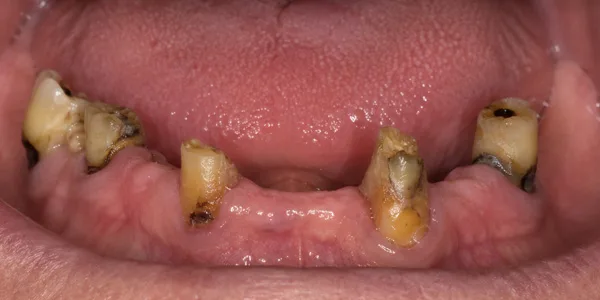
✓ Typically Possible When
Most or all teeth are missing or failing in one jaw

Most or all teeth are missing or failing in one jaw

Once several teeth in an arch are compromised, treating each individually with its own implant becomes more invasive, more expensive, and structurally weaker than restoring the whole arch as one connected system.
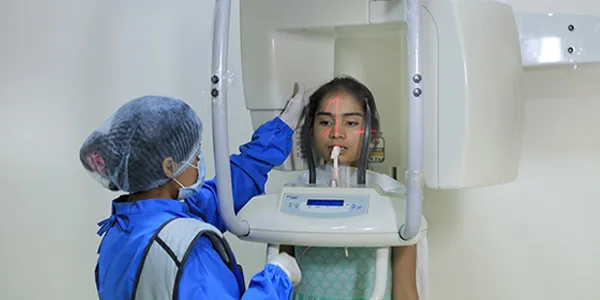
CBCT shows adequate bone in the front side of the jaw

CBCT shows adequate bone in the front side of the jaw

Specifically: enough vertical height at the two front sockets, and enough density just anterior to the sinus or nerve canal to seat the tilted pair at the planned 30–45° angle without compromise.
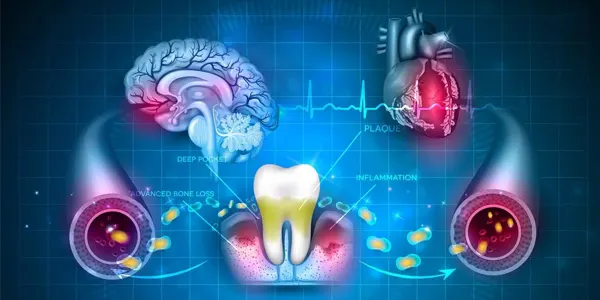
Systemic health is stable

Systemic health is stable

Controlled diabetes (not necessarily diabetes-free), no active periodontal infection at the surgical site, and cardiovascular status cleared for a procedure that can run four to five hours.
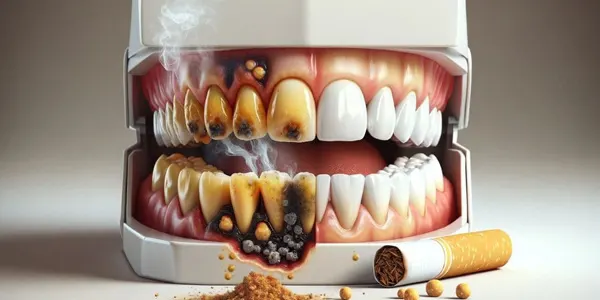
Willing to pause smoking through healing

Willing to pause smoking through healing

Nicotine constricts the small blood vessels that supply healing bone. The biggest risk window is the first 8–10 weeks after surgery — exactly when smoking does the most damage to integration.
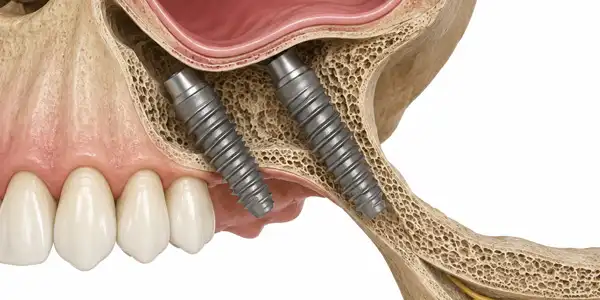
⚠ All-on-4 is not possible when
Bone loss extends past where tilting can reach

Bone loss extends past where tilting can reach

If even the angled posterior position lacks sufficient bone, four implants can't achieve reliable primary stability — this is the specific point where zygomatic implants, anchored in the cheekbone rather than the jaw, become the relevant alternative.
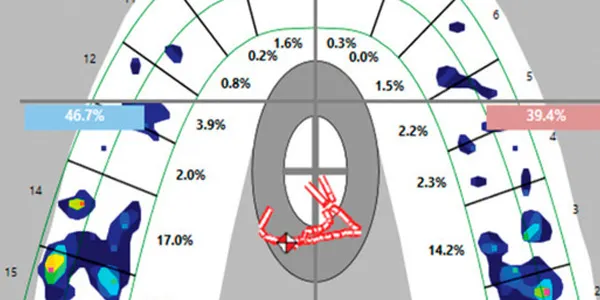
Very high bite force, limited bone density

Very high bite force, limited bone density

Documented heavy bruxism on borderline bone concentrates more force per implant than four can comfortably carry long-term — this is precisely the scenario All-on-4 Plus exists to address, covered just below.
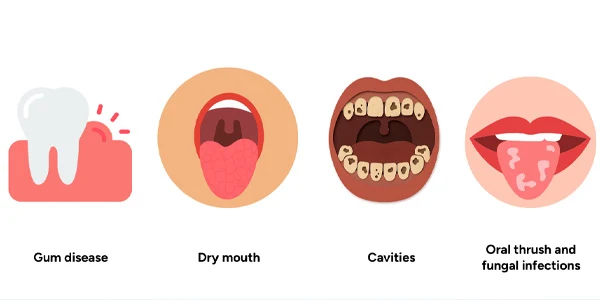
Uncontrolled diabetes or active infection

Uncontrolled diabetes or active infection

Both directly impair the bone's ability to heal around titanium. Treatment is sequenced rather than declined outright — stabilise the underlying condition first, then reassess candidacy with a fresh CBCT.
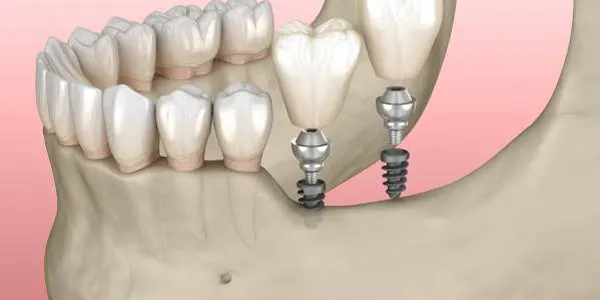
Jaw growth not yet complete

Jaw growth not yet complete

Implants don't move with growing bone the way natural teeth do. Placed before skeletal maturity, an implant can end up in the wrong position — too far forward, too far back, or at the wrong height — as the jaw continues to develop around it.

CANDIDACY IS IMAGING-BASED

Determined by imaging, not conversation

A CBCT scan at your assessment maps bone height, width, and density at all four planned positions before any recommendation is made — the same scan that rules All-on-4 in also rules it towards a different protocol when that's the honest answer.

A Natural Extension

What is All-on-4 Plus ? An Extension to All on 4

When one or two more implants are the right call — and exactly when they aren't.

All-on-4 Plus is the same tilted-implant geometry and same-day loading philosophy as standard

All-on-4, with one or two additional implants at intermediate points along the arch — for cases where four alone would carry more load, long-term, than is biomechanically comfortable.

Adding one or two implants doesn't change the underlying logic of the protocol; it changes the math. Four implants spread a given bite force across four contact points. Six spread the same force across six — each implant individually carries less, which matters over a 15 or 20-year horizon in patients who put unusually high load through their bite, or whose arch is simply wider than average and would otherwise leave a longer unsupported span between implants.

This is a CBCT-driven decision, not a preference-driven one. Dr. Shailaja Reddy recommends All-on-4 Plus specifically when imaging shows a broader-than-average arch, a documented history of heavy bruxism or high bite force, or bone density and volume that comfortably support six well-distributed implant sites rather than four under more concentrated load. If a case doesn't show any of these factors, standard All-on-4 already does the job completely — the additional surgical time, the one or two extra implants, and the higher cost aren't recommended without a specific clinical reason behind them. It is never offered as a default upgrade.
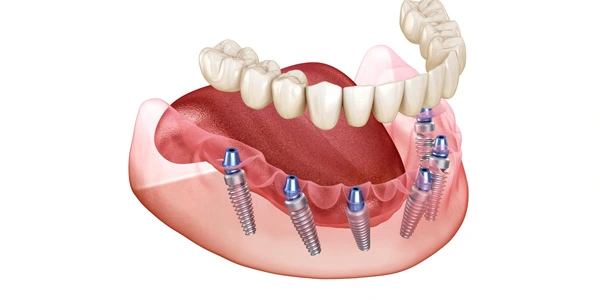
Standard All-on-4

Standard All-on-4 in Hyderabad
4

Implants

Average arch, average bite force.
TREATMENT SELECTION

Comparing against All-on-6, zygomatic, or conventional full-arch instead? See our full mouth implant options page.

Recovery

All on 4 Procedure from Surgery to Your Final Bridge & Post Treatment Care

Recovery from All-on-4 isn't a single event — it's a four-to-six month biological process happening underneath a bridge you're already eating and speaking with from day one.

🧊
Days 1–3 · Acute phase

Swelling, and managing it properly

Swelling typically peaks around day 2–3, and given the extent of surgery — four implants and often extractions in one session — it's generally more noticeable than after a routine extraction. Cold compresses in the first 48 hours and prescribed anti-inflammatory medication keep it manageable. Diet is liquids and very soft food only; this is not the window to test the limits of the provisional bridge.

💬
Days 4–10 · Early settling

Swelling recedes, speech starts adapting

Swelling drops off noticeably over this window. The provisional bridge has more bulk against the tongue and palate than your natural teeth or gums did, so speech — particularly "s" and "f" sounds — often feels different here; this is mechanical adaptation, not a sign of a problem. Sutures, where used, are typically removed around day 10.

🥗
Weeks 3–6 · Soft-food function

Diet progresses, implants stay protected

Diet moves on to soft solids — well-cooked vegetables, fish, eggs, soft pasta. The provisional bridge is functional but still being protected; hard, crunchy, or sticky foods stay off the menu specifically because the implants underneath are still in the early stages of integrating and shouldn't absorb sudden, concentrated force.

🔬
Months 2–3 · Quiet integration

The least eventful phase, deliberately

This stretch is meant to be uneventful. Bone is fusing to the implant surface at a cellular level with no outward symptoms to track. Routine check-ins during this period simply confirm the bridge remains stable and the bite hasn't shifted — there's no active treatment happening, which is exactly the point.

📷
Months 4–6 · Integration confirmed

Imaging decides the timeline, not a calendar

Bone-level imaging, or sometimes a controlled stability check on each implant, confirms osseointegration is genuinely complete on all four implants. This — not a fixed number of weeks — is what triggers the move to the definitive bridge. Most cases land in this window, but the imaging is what actually decides it.

💎
Final visit · Definitive bridge

The permanent restoration is fitted

Digital impressions, taken chairside without trays or putty, replace the provisional with your chosen permanent bridge — acrylic hybrid or zirconia. Fit, bite, and aesthetics are verified before you leave. Full normal diet resumes once it's in place.

Transparent Pricing 2026

What Is the Cost of All-on-4 Dental Implants by Implant Brand?

The biggest driver of price difference is the implant brand itself, besides this, the type of framework or the crowns given determines the cost of All-on-4. Here's exactly what each tier costs.

All-on-4 at FMS Dental starts from Rs. 4,00,000 per jaw using Alpha-Bio or Osstem implants with an acrylic wrap-around. It costs Rs. 5,00,000 per jaw when Nobel Biocare or Straumann BLX is used. Every figure includes CBCT, surgery, the same-day bridge, the named brand in writing and a lifetime warranty.

Mid-Tier · Excellent Value
Osstem & Alpha-Bio
South Korea & Israel · Well-documented systems
Acrylic wrap-around with hybrid prosthesis starts from ₹4,00,000+/jaw
Individual Zirconia Crowns on a Titanium framework starts from ₹5,00,000+/jaw

Recommended for healthy non-smokers with adequate bone — strong clinical data, dependable osseointegration, genuine cost saving without compromise.

The Bridge Itself

Acrylic Hybrid or Zirconia

Both materials sit on the same four implants. The difference is what you'll notice day to day, and what it takes to keep looking right ten years from now.
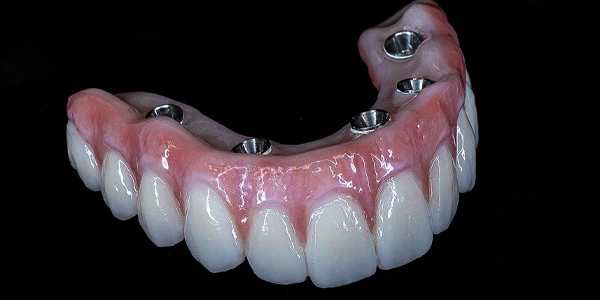
Acrylic Hybrid
Acrylic Hybrid in Hyderabad
Titanium bar + cross linked acrylic teeth

A milled titanium bar provides the rigid internal framework; denture-grade acrylic resin is layered over it to form the visible teeth and gum-coloured base. This is also the standard material used for the provisional bridge fitted on surgery day itself, so many patients are already familiar with how it feels before the definitive version is even made.

It's noticeably lighter than zirconia, which some patients prefer for comfort, and if a tooth chips or a clip needs adjusting, it can usually be repaired chairside the same day rather than sent out to a lab. The trade-off is that the acrylic surface wears and can pick up staining over many years of normal use — manageable, but worth knowing upfront.
An Honest Account

What Are the Risks of All-on-4 Dental Implants and How Common Are They?

<2%

Individual implant failure

With four implants splinted together, a single failure doesn't always mean losing the bridge.

Most common

Screw loosening

A maintenance visit, not implant failure — caught at routine check-ins.

Uncommon

Cantilever fracture

From hard food before integration is complete.

Rare

Nerve or sinus involvement

The entire purpose of the tilt is to avoid these structures.

Long-term

Peri-implantitis

The single biggest controllable risk factor over years of use.

Elevated risk

Smoking & uncontrolled diabetes

Both measurably reduce survival figures.

Who Performs It

Who Performs All-on-4 Dental Implant Treatment at FMS Dental?

All-on-4 at FMS Dental is never a solo procedure on paper — it's built around two specialists whose roles overlap exactly where the case gets complicated.

SR

26+ years in implant dentistry, with All-on-4 specifically since FMS Dental introduced the protocol in 2008 — among the longest continuous track records with this exact technique in Hyderabad India. She leads the digital treatment plan for every All-on-4 case: reading the CBCT, positioning each of the four implants virtually before surgery, and making the in-theatre call on immediate versus delayed loading based on the torque readings as they come in.

Full profile →

Meet Our Team of ALL-ON-4 Implant Specialist

ALL-ON-4 — is a multi-specialist procedure. This is Our Expert Implant Dentists team.

Best Dental Implantologist
Dental Implantology
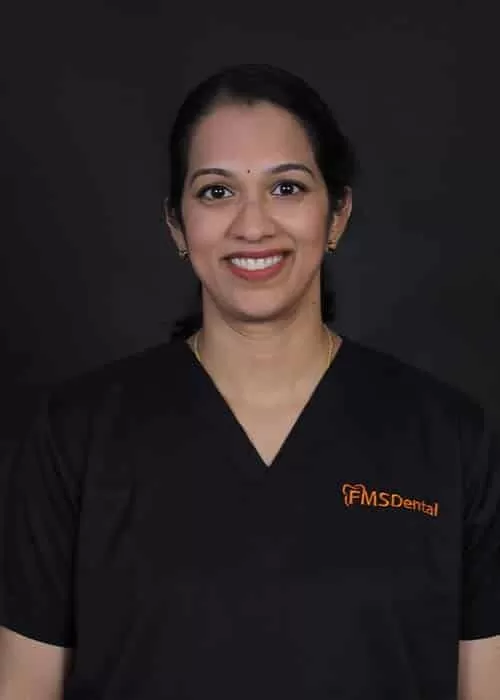
Dr. Shailaja Reddy
Chief Implantologist & ICOI Member, USA
View Profile
Maxillofacial Surgery
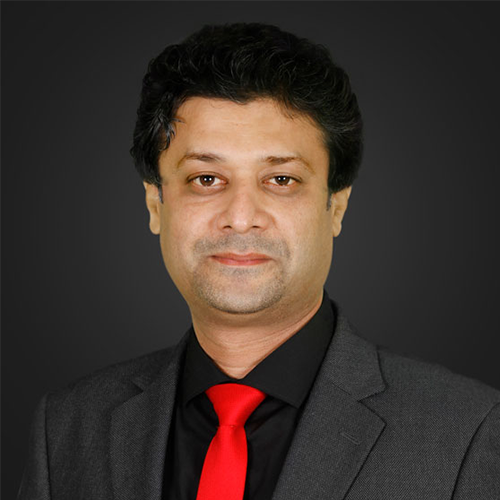
Dr. Dushyanth Paul
Senior Oral & Maxillofacial Surgeon
View Profile
Maxillofacial Surgery
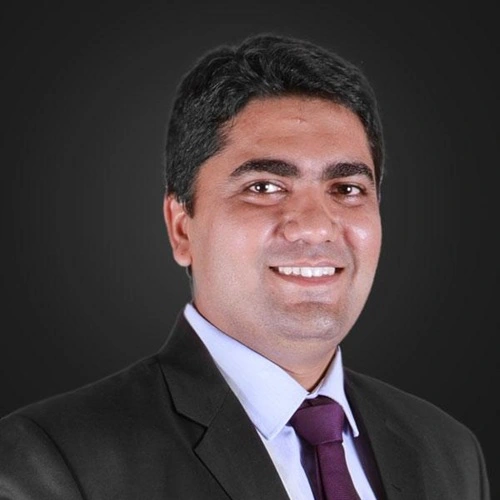
Dr. Prabhat Tiwari
Senior Oral & Maxillofacial Surgeon
View Profile
Oral & Maxillofacial Surgeon
Maxillofacial Surgery
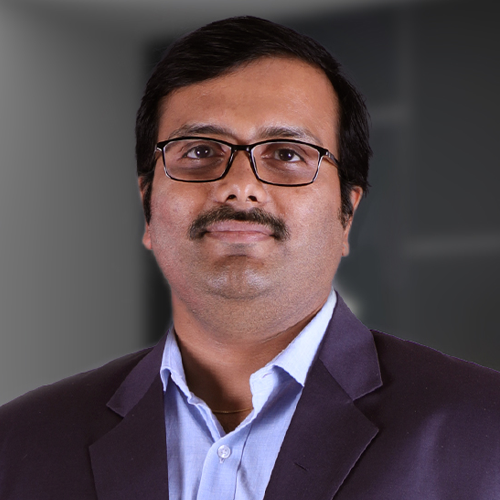
Dr. Sasank K
Senior Oral & Maxillofacial Surgeon
View Profile
Prosthodontist
Prosthodontist
Dr. Kavya
Senior Prosthodontist
View Profile
 Senior Prosthodontist
Prosthodontist
Dr. S. Venkat Aditya
Senior Prosthodontist
View Profile
Senior Cosmetic Dentist
Cosmetic Dentist
Dr. Parthasaradhi Reddy
Senior Cosmetic Dentist
View Profile
Best Dental Implantologist
Dental Implantology
Dr. Shailaja Reddy
Chief Implantologist & ICOI Member, USA
View Profile
Maxillofacial Surgery
Dr. Dushyanth Paul
Senior Oral & Maxillofacial Surgeon
View Profile
Maxillofacial Surgery
Dr. Prabhat Tiwari
Senior Oral & Maxillofacial Surgeon
View Profile
Oral & Maxillofacial Surgeon
Dr. Sasank K
Senior Oral & Maxillofacial Surgeon
View Profile
Prosthodontist
Prosthodontist
Dr. Kavya
Senior Prosthodontist
View Profile
 Senior Prosthodontist
Prosthodontist
Dr. S. Venkat Aditya
Senior Prosthodontist
View Profile
Senior Cosmetic Dentist
Cosmetic Dentist
Dr. Parthasaradhi Reddy
Senior Cosmetic Dentist
View Profile

Why a Team Matters for Complex Cases:

All-on-4 dental implant cases involve anatomy that extends beyond implant placement — sinus cavities, cranial base structures and complex occlusal loading. FMS having Oral & Maxillofacial Surgeons, Prosthodontists and experienced implantologists plan together for delivering better end results. At FMS Dental, complex surgical decisions are reviewed jointly before the patient enters the operating room.

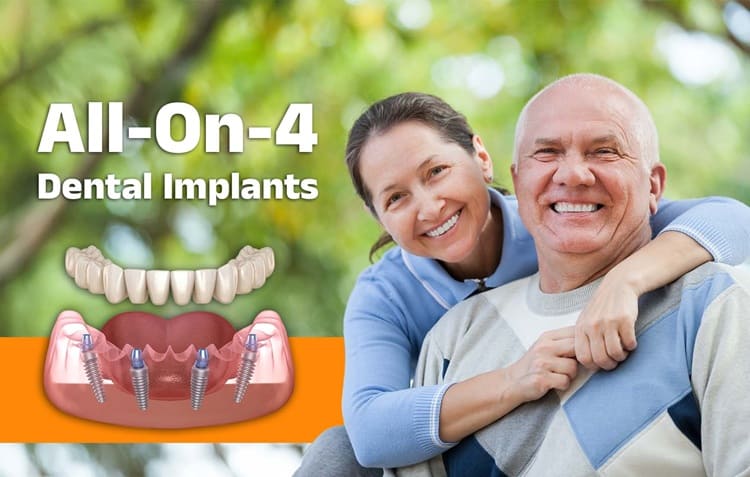
Successful All-on-4 Treatment Cases at FMS Dental

I'd worn a lower denture for six years and assumed implants were off the table. The CBCT showed enough bone for the tilted back implants. I walked out the same day with a fixed bridge.

Lower jaw All-on-4

Long-term denture wearer, age 61
★★★★★

I chose mid-tier Osstem since my bone was healthy and I wasn't diabetic — the team explained exactly why it was reasonable for my case rather than upselling me. Three years on, solid.

Upper jaw All-on-4

Osstem implants, age 49
★★★★★

The hardest part wasn't surgery, it was the first ten days adjusting how I spoke — a real adaptation period nobody mentioned elsewhere. By week three it was completely normal.

Both jaws All-on-4

Sequential treatment, age 58
★★★★★


Travelling for Treatment

Get All-on-4 Dental Implants in a Single Dental Trip to India

Because the provisional bridge is fitted the same day as surgery, the part of All-on-4 that genuinely requires you to be in Hyderabad India is short — typically a week. The 4–6 month integration period happens wherever you are.

WhatsApp to Plan Your Trip
Trip
Duration
What Happens
Trip 1
5-7 days
CBCT, surgery, provisional bridge
At home
4–6 months
Osseointegration — no travel
Trip 2
~7–10 days
Definitive bridge fitted
FAQs

FAQs on All on 4 - Everything You Need to Know About All-on-4 Dental Implants

How much does All-on-4 cost at FMS Dental? +

All-on-4 starts from Rs. 4,00,000 per jaw using mid-tier Osstem or Alpha-Bio implants with an acrylic bridge. Premium Nobel Biocare or Straumann starts from Rs. 5,00,000 per jaw (acrylic) or Rs. 6,00,000 (zirconia). All-on-4 Plus starts from Rs. 7,00,000 per jaw.

What is the difference between Osstem/Alpha-Bio and Nobel Biocare/Straumann? +

Osstem and Alpha-Bio are well-documented mid-tier systems, ideal for straightforward cases in healthy patients. Nobel Biocare and Straumann are premium systems with decades of research and surface technologies (TiUnite, SLActive) recommended for diabetic patients, smokers, or compromised bone.

Will FMS Dental tell me which implant brand I'm getting? +

Yes. The exact brand is named in writing on your treatment plan before surgery, never substituted at the chair.

Is a mid-tier implant a safe choice or a compromise? +

For a healthy, non-smoking patient with adequate bone volume, Osstem or Alpha-Bio is a clinically sound choice, not a compromise. The recommendation shifts toward premium for higher-risk cases.

Does the warranty differ between mid-tier and premium implants? +

No. FMS Dental's lifetime warranty applies across both tiers, subject to annual review attendance.

Why are only two of the four implants tilted in All-on-4? +

The two posterior implants are tilted 30 to 45 degrees specifically to reach denser bone further back while avoiding the maxillary sinus (upper jaw) or the mental nerve canal (lower jaw). A straight implant in that same rear position would often run directly into one of those structures.

Does tilting the implants weaken them? +

No — tilting doesn't reduce an implant's strength. A tilted implant of a given length contacts more linear bone than the same implant placed straight down. The tilt also shortens the unsupported rear section of the bridge, reducing the bending force the posterior implants resist.

Why does All-on-4 use exactly four implants and not more?+

Four is the minimum number that can support a full arch while spreading load across a wide front-to-back distance. Adding more implants, as in All-on-6 or All-on-4 Plus, suits patients with higher bite forces — but four, positioned correctly, is sufficient for most cases.

What is insertion torque and why does it decide same-day teeth?+

Insertion torque is the resistance an implant offers as it's seated into bone, measured in Newton-centimetres. At FMS Dental, the threshold for same-day loading is roughly 35 Ncm or higher across all four implants.

What happens if one implant doesn't reach the torque threshold? +

Because all four implants are splinted together through one rigid bridge, the other three can carry a borderline implant's share of the load temporarily. In rarer cases, the plan shifts to delayed loading for that arch.

SURGERY DAY Hour by Hour, From Arrival to Fixed Teeth +

📋 HOUR 0 Arrival & final check Vitals confirmed, surgical plan reviewed once more, anaesthesia administered.
🦷 HOUR 0.5–1 Extractions, if any Failing teeth remaining in the arch are removed in the same session.
🔩 HOUR 1–2.5 Implant placement Anterior implants placed vertically first, then posterior implants tilted to the planned angle. Each torque-tested on seating.
📊 HOUR 2.5–3 The loading decision With torque values known, the surgeon confirms suitability for immediate loading.
😁 HOUR 3–4.5 Provisional bridge fitted Connected to all four implants and screwed into place — rigid, not removable by you.
✅ HOUR 4.5–5 Bite check & discharge Occlusion adjusted. You leave with a fixed bridge already in place.
What you leave with: a screwed-in provisional bridge, not a denture and not a gap.

How do I clean under a fixed All-on-4 bridge? +

A water flosser at the gumline, used daily, is the most effective habit for preventing peri-implantitis.

Can I eat normally for life with All-on-4?+

Once the definitive bridge is fitted, function approaches natural teeth for most foods. Extremely hard items are still worth avoiding.

Do All-on-4 implants need replacing eventually? +

The implants are designed to be permanent. The bridge material may need attention: acrylic around 8–12 years; zirconia generally doesn't.

What does the annual review check?+

Implant stability, screw tightness, and bone levels via X-ray — and it keeps your warranty in force.

Will people tell I have All-on-4 implants? +

Visually, no — both bridge materials are shade-matched to look like a natural arch.

How long until swelling goes down after surgery?+

Swelling typically peaks around day 2–3 and recedes substantially over the following week.

When can I eat normally again? +

In stages: liquids for the first few days, soft solids from week 3, full normal diet once the definitive bridge is fitted at 4–6 months.

Why does my speech sound different afterward? +

The provisional bridge has more bulk against the palate, temporarily changing certain sounds. This typically resolves within 1–2 weeks.

How do I know when osseointegration is complete? +

Confirmed clinically through bone-level imaging, generally at 4 to 6 months — not a fixed calendar date.

Is the provisional bridge the same as the final one? +

No. The provisional is a protective interim piece. The definitive bridge is separately fabricated in your chosen final material.

How is candidacy for All-on-4 actually determined? +

Through a CBCT 3D scan, not a visual exam. The scan measures bone height, width, and density at the exact four positions a digital plan would use.

Can I get All-on-4 if I've worn dentures for many years? +

Often, yes. Long-term denture wear affects the crest of the ridge more than the bone further back — precisely the bone the tilted posterior implants are designed to reach.

Is there an age limit for All-on-4? +

There's no fixed upper age limit. Candidacy is governed by bone quality and general health stability rather than age alone.

What disqualifies someone from All-on-4 specifically? +

Insufficient bone even at the tilted posterior position, uncontrolled diabetes or active periodontal infection, and unwillingness to pause smoking through the healing window.

Do I need a bone graft before All-on-4? +

Usually not. Most patients with moderate bone loss qualify without grafting, since the tilted implants reach bone that's still present.

Find Out If All-on-4 Fits Your Bone
A CBCT scan maps bone height, width, and density at the exact four points an All-on-4 plan depends on — and gives you an honest brand recommendation.
All-on-4 Dental Implants Cost in Hyderabad — FMS Dental

All-on-4 Dental Implants Cost in Hyderabad — FMS Dental

Read More
All-on-4 Dental Implants: A New Smile in Just One Day

All-on-4 Dental Implants: A New Smile in Just One Day

Read More
FLOATING DENTURES? ….ALL-ON-4 DENTAL IMPLANTS COULD BE THE SAVIOUR

FLOATING DENTURES? ….ALL-ON-4 DENTAL IMPLANTS COULD BE THE SAVIOUR

Read More

3D Guided Implant Technology for Perfect Implant Placement

Read More

Full Mouth Dental Implants Cost in Hyderabad – Complete Price Breakdown by FMS Dental

Read More

Dental Implants for Full Mouth Rehabilitation: A Life-Changing Solution

Read More

Dental Implants in Hyderabad, India – Your Complete Guide from FMS Dental

Read More

3D Guided Implant Technology for Perfect Implant Placement

Read More