Dental Implant Surgery

Dental Implant Surgery: What to Expect, Step by Step

Most of the anxiety around dental implants has little to do with the implant itself… it's about the unknown. What does the surgery actually involve? Will it hurt? How long before you can eat normally again?

At FMS Dental, we believe patients make calmer, better decisions when they know exactly what's ahead, which is why we walk them through the entire journey: how the surgery is performed, how anaesthesia is chosen, what recovery really looks like week by week and how our follow-up protocol protects your implant for the long term.

Every implant placed at FMS Dental is planned and performed under the direct clinical oversight of Dr. Shailaja Reddy, Chief Implantologist, who has placed over 25,000 implants along with her team across more than 26 years of practice. Combined with our in-house FMS CAD-CAM dental laboratory, which designs and fabricates implant components without outsourcing delays, every case moves from diagnosis to surgery to final restoration under one roof, with one team accountable for the outcome.

Dental Implant Surgery at FMS Dental

Am I a Candidate for Dental Implant Surgery?

Most patients who assume they aren't candidates for implants turn out to be… modern bone grafting and full-arch techniques have widened eligibility considerably. Candidacy is assessed on a combination of factors, not any single one:

Adequate jawbone density and volume to anchor the implant, or willingness to undergo bone grafting first.

Healthy gums, free of active, untreated periodontal disease.

Chronic conditions such as diabetes that are medically controlled, not necessarily absent.

Smoking status… smoking measurably slows osseointegration, so patients are advised to pause around the surgical window.

General fitness for minor surgery under local or general anaesthesia.

Age Is Not a Limitation

Age by itself is not disqualifying… FMS Dental has successfully placed implants for patients well into their 70s and 80s with appropriate planning.

Clinical Evaluation Required

The only way to confirm candidacy is a clinical evaluation and CBCT scan during consultation. This comprehensive assessment allows our implant team to evaluate bone quality, gum health and overall oral condition before creating a personalised treatment plan.

Dental Implants Treatment Options

What are the Types of Dental Implant Surgery?

Not every implant case looks the same. The right surgical approach depends on how many teeth are missing and the condition of the underlying bone.

Single-Tooth Implant

Single-Tooth Implant

Replaces one missing tooth without affecting adjacent teeth.

Multiple-Teeth Implants / Implant-Supported Bridge

Multiple-Teeth Implants / Implant-Supported Bridge

Replaces several adjacent missing teeth on fewer implants than teeth.

Full-Arch Implant Solutions

replaces an entire arch of teeth on four to six strategically placed implants

6–8 Straight Implants per Jaw

6–8 Straight Implants per Jaw

For patients with good jaw bone, 6–8 straight implants per jaw are placed to replace missing teeth.

All-on-4 / All-on-4 Plus Implant Surgery

All-on-4 / All-on-4 Plus Implant Surgery

Replaces an entire arch of teeth on four to five strategically placed implants.

Zygomatic & Pterygoid Implants

Zygomatic & Pterygoid Implants

Designed for patients with severe upper-jaw bone loss who would otherwise require extensive bone grafting before treatment.

Immediate-Load / Teeth-in-a-Day

Immediate-Load / Teeth-in-a-Day

A fixed provisional prosthesis is fitted on the same day surgery is performed, where clinically appropriate.

Bone Graft or Sinus Lift + Implant

Bone Graft or Sinus Lift + Implant

Bone augmentation is performed before or during implant placement to create sufficient bone volume for long-term implant stability.

Pre-Surgical Preparation

How do you Prepare for Your Dental Implant Surgery?

Preparation reduces both surgical risk and day-of anxiety. A typical pre-surgical pathway includes:

1

Initial Consultation & Clinical Examination

Initial consultation and clinical examination of teeth, gums and bite.

2

3D CBCT Scan & Digital Planning

3D CBCT scan and digital treatment planning to accurately map the bone, nerves and sinus position before implant placement.

3

Medical History Review

Medical history review, including current medications and chronic conditions, with medical clearance obtained where required.

4

Anaesthesia Preparation

Anaesthesia-specific instructions are provided, including fasting before general anaesthesia and arranging for someone to drive you home after the procedure.

5

Final Treatment Review

A final review of the treatment timeline and anaesthesia choice is completed before the surgery date is confirmed.

Dental Implant Step-by-Step Procedure

How Is Dental Implant Surgery Performed? (Step-by-Step Procedure at FMS Dental)

Dental implant surgery follows a structured, staged process. While the exact protocol is customised to each patient's bone quality, missing-tooth count and medical history, the core steps are consistent.

1

Diagnostic Planning

Diagnostic Planning

3D CBCT (Cone Beam CT) imaging maps bone density, nerve position and sinus location to plan implant size, angle and position with precision.

2

Anaesthesia Administration

Anaesthesia Administration

The surgical site is numbed using local anaesthesia, or the patient is sedated under general anaesthesia for more extensive or multi-implant cases.

3

Site Preparation

Site Preparation

A small access point is created in the gum to expose the jawbone at the planned implant position.

4

Implant Placement

Implant Placement

A titanium implant engineered to fuse with bone is precisely positioned into the jawbone using the pre-planned trajectory.

5

Closure

Closure

The gum tissue is closed around or over the implant, depending on the protocol (single-stage vs two-stage surgery).

6

Healing Period (Osseointegration)

Healing Period (Osseointegration)

Over the following weeks to months, the implant fuses biologically with the surrounding bone, forming the stable foundation for the final crown, bridge or denture.

7

Restoration

Restoration

: Once integration is confirmed abutment and the final prosthetic (crown / bridge / denture) are fitted. – in select cases, this can happen the same day (see our Teeth-in-a-Day protocol).

Immediate Function for Advanced Implant Cases

For patients requiring immediate function—such as full-arch rehabilitation with All-on-4 or Zygomatic implants—the sequence is adapted so a temporary prosthetic can be fitted on the day of surgery.


Our clinical team evaluates each case individually to determine whether immediate loading is appropriate, as this depends on the implant stability achieved at placement, not on patient preference alone.

Anaesthesia Options for Dental Implant Surgery

Local Anaesthesia vs. General Anaesthesia for Dental Implants

Anaesthesia choice is one of the most common questions patients bring to a consultation, and it genuinely changes how the day feels. FMS Dental offers both options, with the right choice depending on the number of implants, the complexity of the case, and the patient's anxiety levels or medical history.

Local Anaesthesia (LA)

Local anaesthesia numbs only the surgical area while the patient remains fully awake and aware throughout. It is the standard approach for:

Recommended For
  • Single or a few implants in a straightforward site.
  • Patients with no significant dental anxiety.
  • Cases where same-day recovery and driving home unassisted matters.

Most single-tooth and small multi-tooth implant cases at FMS Dental are comfortably completed under local anaesthesia alone.

General Anaesthesia (GA)

General anaesthesia puts the patient in a controlled, unconscious or deeply relaxed state for the duration of surgery. It is typically recommended for:

Typically Recommended For
  • Full-mouth or full-arch implant surgery (All-on-4, Zygomatic, or Teeth-in-a-Day) where procedure length would be uncomfortable while fully awake.
  • Patients with significant dental anxiety or a strong gag reflex.
  • Complex bone grafting or sinus lift procedures performed alongside implant placement.

Clinical Safety & Planning

GA cases are administered and monitored by qualified anaesthesia specialists, with pre-operative medical clearance to confirm the patient is a safe candidate. This is always discussed and agreed upon during the consultation, never decided on the day of surgery.

Advanced Implant Preparation Procedures in select cases

Bone Grafting & Sinus Lift: When is Extra Preparation Needed in my case?

Some patients don't have enough bone volume to support an implant right away… usually the result of long-term tooth loss, gum disease, or in the upper back jaw, natural sinus proximity. In these cases, treatment is staged.
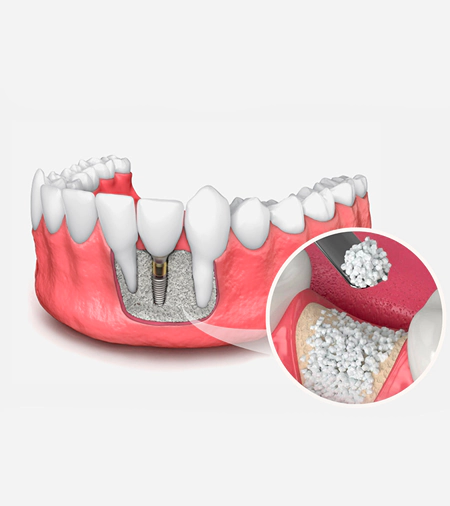
Bone Grafting

Bone Grafting

Bone grafting adds material to build up width or height in the jaw before (or sometimes during) implant placement.

Sinus Lift

A sinus lift raises the floor of the sinus to create enough vertical bone for implants in the upper back jaw.

Zygomatic & Pterygoid Implants

For eligible patients, these implants can avoid grafting altogether by anchoring into denser bone elsewhere in the skull.

CBCT Guided Decision

Whether grafting is needed and which alternative fits best is determined from the CBCT scan during planning, not guessed at chairside.

Loading Protocols at FMS Dental

Immediate-Load vs. Delayed-Load Implants: Which Protocol Should I Opt for?

This is one of the most misunderstood parts of implant treatment, largely because "same-day teeth" is used loosely in marketing. In reality:

Delayed Loading

Delayed loading is the standard, most predictable protocol. The implant is left undisturbed to fully osseointegrate before the final crown, bridge or denture is attached.

Immediate Loading

Immediate loading fits a temporary prosthetic on the day of surgery or within 72 hours. It is only appropriate when the implant achieves sufficient primary stability at placement—a clinical measurement, not a patient preference.

Clinical Decision by Senior Implantologists

The senior Implantologists at FMS Dental, led by Dr. Shailaja Reddy, determine which protocol applies to your case based on bone quality, implant position and stability readings taken during surgery itself.

Recovery Timeline After Dental Implant Treatment

Dental Implant Recovery: What to Expect, Week by Week

Recovery timelines vary by case complexity, number of implants and individual healing response, but most patients follow a broadly predictable curve.

1

First 24–48 Hours

Mild swelling, tenderness and minor bleeding are normal. Prescribed pain management and a soft-food diet help keep this period comfortable.

2

First Week

Swelling and discomfort steadily reduce. Most patients return to normal daily activity within a few days, while avoiding strenuous exercise.

3

2–6 Weeks

Initial soft-tissue healing is complete and the implant begins osseointegration, gradually fusing with the jawbone.

4

3–6 Months (Standard Protocol)

Full osseointegration is typically confirmed before the final crown or bridge is fitted. This period is usually shorter for the lower jaw and may extend for upper-jaw or grafted sites.

5

Same-Day to 72 Hours (Select Cases Only)

For edentulous patients receiving a full-arch implant-supported denture, or cases using a pre-planned surgical guide, a provisional prosthesis can be fitted immediately or within 72 hours. This protocol does not apply to isolated posterior single-tooth cases, which always follow the standard healing protocol.

Post-Operative Care

What are the Do's and Don'ts after Dental Implant Surgery?

✔ Do

  • Stick to a soft-food diet for the first few days.
  • Apply a cold compress to reduce swelling during the first 24 hours.
  • Take all prescribed medications on schedule, including the full course of any antibiotics.
  • Rinse gently with the prescribed mouthwash after the first 24 hours.
  • Rest and avoid unnecessary exertion for the first few days.

✕ Don't

  • Smoke – it significantly slows healing and raises implant-failure risk.
  • Use straws – the suction can dislodge the healing blood clot.
  • Eat hard, crunchy, or sticky foods until cleared by your surgeon.
  • Rinse or spit vigorously during the first 24 hours.
  • Skip scheduled follow-up visits, even if you feel fine.

Following Post-Surgical Instructions Matters

Following these instructions carefully supports uneventful healing, promotes successful osseointegration, and helps reduce the risk of avoidable complications. Every patient at FMS Dental receives detailed written post-operative instructions and scheduled follow-up reviews to monitor healing and ensure the implant integrates successfully.

Which Dental Implant Clinic is best for Post-Operative Care in Hyderabad?

What to Expect During Post-Operative Care & Follow-Up Protocol at FMS Dental

Implant success is determined as much by post-operative care as by the surgery itself. FMS follow-up protocol includes:

1

Same-Day Post-Operative Instructions

Same-day post-op instructions covering diet, oral hygiene, medication schedule and warning signs to watch for.

2

First Follow-Up Visit

A scheduled follow-up visit within first week to check healing and address any discomfort.

3

Osseointegration Reviews

Periodic review appointments throughout the osseointegration period to confirm that the implant is integrating as expected.

4

CBCT / OPG Imaging Review

A CBCT or OPG imaging review before the final restoration is placed, to confirm the implant is ready to bear load.

5

Long-Term Maintenance

Long-term maintenance guidance, since implants, like natural teeth depend on consistent hygiene and periodic professional check-ups (at least once in 6 months) to last.

One Clinical Team from Start to Finish

Because diagnosis, surgery and restoration all happen within the same clinical team, follow-up care isn't handed off between providers... the Implantologist / Oral & Maxillofacial Surgeon who placed the implant is part of the team reviewing your recovery.

Warning Signs During Recovery after your ImPlant Surgery

What could be the signs of a Problem: When to Contact Your Dentist?

Complications are uncommon when post-operative instructions are followed, but knowing the warning signs means small issues get caught before they become bigger ones. Contact your dental team if you notice:

!

Increasing Pain or Swelling

Pain or swelling that increases rather than decreases after the first few days.

🩸

Persistent Bleeding

Bleeding that continues beyond the first 24 hours.

Implant Movement

Any looseness or movement in the implant should be assessed immediately.

🌡

Fever

A fever may indicate infection and should be reported promptly.

+

Pus or Discharge

Pus, discharge or a persistent bad taste at the surgical site.

Seek Same-Day Advice

None of these are common outcomes, but they are worth same-day attention rather than waiting for your next scheduled visit.

Why do Dental Implant Costs Vary from clinic to clinic?

What Influences the Cost of Dental Implant Surgery?

Implant costs vary meaningfully from patient to patient, which is why FMS Dental doesn't quote a flat number without an examination. The main factors are:

1

Number of Implants

Number of implants required.

2

Treatment Type

Single-tooth vs. full-arch treatment.

3

Bone Grafting

Whether bone grafting or a sinus lift is needed beforehand.

4

Implant Brand

The implant brand and material used.

5

Digital Surgery

Whether CT-guided digital surgery is used for implant placement.

6

Anaesthesia & Restoration

Anaesthesia type - local vs. general

6

Complexity

Complexity of the final prosthetic (crown, bridge or full-arch denture)

Personalised Treatment Estimate

A personalised quote is provided after your consultation and CBCT scan, once your specific treatment plan is clear.

Advanced Dental Implant Technology at FMS Dental

What is the Technology used behind Precision Implant Surgery at FMS Dental?

Dental Implant Technology
01

3D CBCT Imaging

3D CBCT imaging for accurate pre-surgical mapping of bone, nerves and sinus position

02

Digital Guided Surgery

Digital planning and guided surgery protocols that improve implant placement precision and can reduce surgical time.

03

In-House FMS CAD-CAM Lab

In-house FMS CAD-CAM dental lab for same-roof design and fabrication of implant components and prosthetics.

04

NABH-Accredited Protocols

NABH-accredited sterilization and surgical protocols across the FMS International Dental Center, an advanced dental implant clinic in Hyderabad, India.

Why FMS Dental for Dental Implants?

Why Should I Choose FMS Dental for My Dental Implant Surgery?

At FMS Dental, the first implant was placed in 1999 by Dr. Shailaja Reddy. Since then, thousands of dental implants have been placed by her team of Oral & Maxillofacial Surgeons and Implantologists.

26+ Years of Implantology

26+ years of dedicated implantology experience under Dr. Shailaja Reddy, with more than 25,000 implants placed.

In-House CAD-CAM Lab

Precision implant components and prosthetics are designed and fabricated in the FMS CAD-CAM Lab without third-party turnaround delays.

NABH-Accredited Surgical Centre

NABH-accredited surgical protocols at the FMS International Dental Center, Jubilee Hills, Hyderabad, India.

Global Recognition

Ranked #1 in India and #5 globally by the Global Clinic Ratings (GCR).

Integrated Clinical Team

13 branches across Hyderabad and Kochi, with a single accountable clinical team managing diagnosis, surgery, restoration and follow-up.

FMS Dental Implant Team

Experience, Technology & Continuity of Care

From advanced 3D CBCT planning and digital guided implant surgery to an in-house CAD-CAM laboratory, NABH-accredited surgical protocols and one experienced clinical team that stays with you from diagnosis through follow-up, FMS Dental delivers predictable, evidence-based implant treatment with precision, safety and long-term accountability.

FAQs

Frequently Asked Questions

The surgery itself is performed under anaesthesia, so patients do not feel pain during the procedure. Mild soreness and swelling for a few days afterwards is normal and managed with prescribed medication.
A single implant typically takes 30–60 minutes. Full-arch or multi-implant procedures take longer and are usually planned as a half-day or full-day surgical session.
The need for general anaesthesia over local anaesthesia is assessed during your consultation based on the number of implants, procedure complexity and your anxiety levels. Your dental implant surgeon will recommend the appropriate option and explain why.
Most patients move from a soft-food diet to normal eating within 1–2 weeks, though the exact timeline depends on implant location and individual healing.
Implant failure is uncommon but is monitored through scheduled follow-up visits and imaging during the healing period. This is why post-operative follow-up is treated as part of the procedure, not optional.
No. Age alone doesn't disqualify a patient. Overall health and bone quality matter far more than age, and implants are routinely placed for patients in their 70s and 80s.
Delayed loading waits for full osseointegration before fitting the final restoration and is the standard, most predictable approach. Immediate loading fits a temporary prosthetic the same day, but only when the implant achieves sufficient stability at placement.
Not necessarily. It depends on your existing bone volume, assessed via a CBCT scan. Some patients proceed straight to implant placement, while others require bone grafting or a sinus lift first.
The cost of dental implant surgery depends on the number of implants, whether bone grafting is required, the implant brand, and the complexity of the final prosthetic. A personalised treatment estimate is provided after your consultation and CBCT scan rather than quoting a flat figure.