
Choosing a dentist for your child is different from choosing one for yourself. A child's mouth is still growing — milk teeth are guiding permanent teeth into position, jaws are developing, and a single bad experience in the chair can shape how a child feels about dental care for years. That's why pediatric dentistry, or pedodontics, exists as its own speciality: dentists with additional training in child growth, behaviour guidance, and the treatment of both milk and developing permanent teeth.
At FMS Dental's Kids Dental Zone, every child is treated by a senior pedodontist — never a general dentist — in an environment built around comfort, from themed treatment rooms to conscious sedation and general anaesthesia for anxious or uncooperative children. The focus is prevention first: catching problems early, guiding growth, and coaching parents on the daily habits that matter most. From your child's first tooth through the teenage years, care is built around one idea — treat gently, and treat only what truly needs it.
By the first birthday, or within 6 months of the first tooth.
20 teeth; start being replaced from age 6–7.
Cleaning, fluoride & sealants — the core of our approach.
Behaviour guidance, conscious sedation or general anaesthesia.

Pediatric dentistry — also called pedodontics or kids dentistry — is the dental speciality dedicated to the oral health of children from infancy through the teenage years. A pediatric dentist completes additional postgraduate training in child growth and development, child psychology and behaviour guidance, and the treatment of milk teeth and developing permanent teeth. At FMS Dental, our speciality essentially focuses on the diagnosis and treatment of oral health problems, but mainly emphasises the anticipation and prevention of oral health related issues in children.
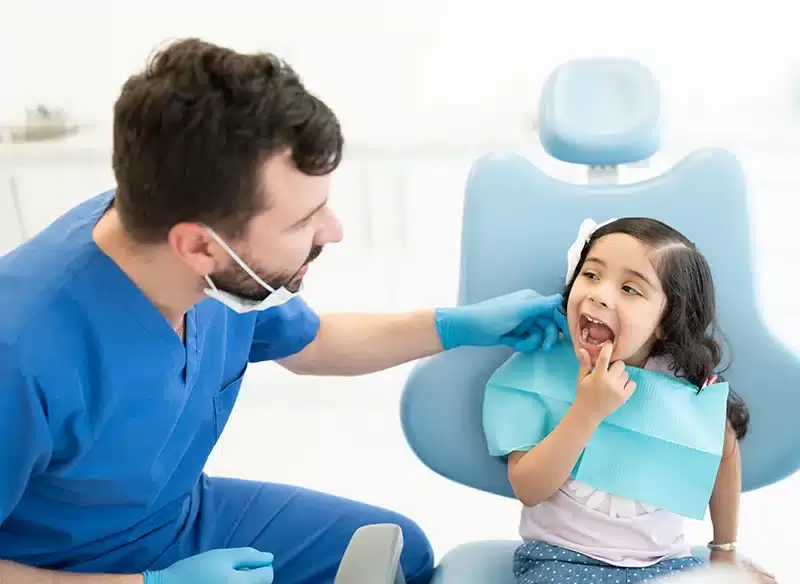
Our pediatric dentists have specialized training to provide personalized care of gums, teeth and overall care of the oral cavity. Our pediatric dentists offer personal counseling to the parents towards the child's nutrition and hygiene habits as well.
That last part matters more than most families expect. Childhood dental disease is overwhelmingly preventable, and the habits set in the first few years — how a child is fed, how often sugar appears, how teeth are brushed and by whom — decide far more than any treatment we provide later.
Treat what needs treating, gently and without fear — but spend most of our effort making sure treatment is never needed again. Every FMS visit combines examination and care with practical coaching for parents on diet, brushing and habits, so children grow up with healthy teeth and no fear of the dentist.

When it comes to choosing a pediatric dentist for your child, you need to look for certain key things.
Our first priority is child-related personalized, gentle, comprehensive and patient-friendly care.
Your child is treated by senior pedodontists (kids dentists), not by a general dentist.
Your child's comfort is very important to us, so we provide conscious sedation and general anaesthesia for uncooperative kids.
Our priority is preventive and interceptive orthodontics to groom your child towards a beautiful smile and face — our pediatric dentists work hand in hand with our senior orthodontists.
We use equipment designed with the safety and efficiency of children in mind.
Hygiene for your kids is equally important, so we follow OSHA standards of sterilisation.
A simple map of what happens in your child's mouth, and what you should be doing at each stage.
Wipe the gums with a clean, damp cloth after feeds. Avoid putting your baby to sleep with a bottle. Teething usually begins near the end of this period.
The lower front teeth usually appear first. Begin brushing with a rice-grain smear of fluoride toothpaste. Book the first dental visit by the first birthday.
All 20 milk teeth are usually in place by about age 3. Wean off the bottle, limit juice, and brush twice daily — parents doing the brushing.
Move to a pea-sized amount of toothpaste. Fluoride application and sealants become valuable. Thumb-sucking should be tapering off. Check-ups every six months.
Kids start losing their first set of teeth (milk teeth) by the age of 6–7 years, which are replaced by permanent or secondary teeth. The first permanent molars erupt behind the milk teeth without any tooth falling out — seal them early.
The ideal age for a first orthodontic check. Crossbites, crowding, jaw discrepancies and habit effects are far easier to guide while your child is still growing.
Milk and permanent teeth coexist. Interceptive treatment, space maintenance and habit correction happen here. Second permanent molars arrive around 12 — seal these too.
Most permanent teeth are in place. Braces or aligners, sports mouthguards, wisdom-tooth monitoring, and coaching on diet and independent brushing.
If you as a parent are anxious about your child's first dental visit, then it is likely that the child will be anxious too. Here is exactly what happens, so there are no surprises for either of you.
Your child meets the team in the FMS Kids Dental Zone and is given time to settle in before anything begins.
The pedodontist explains each instrument in simple words, shows how it works, and only then uses it — nothing comes as a surprise.
Teeth, gums, bite and developing jaws are checked, with X-rays taken only if genuinely required.
We assess your child's decay risk from diet, feeding habits, brushing routine and the condition of the teeth.
You receive personal guidance on nutrition, sugar control, brushing technique and habits such as thumb sucking.
You leave with a clear plan — cleaning, fluoride, sealants or treatment — and a recall date for the next check-up.
Keep your own language neutral and positive. Avoid words like “pain”, “injection”, “drill” or “it won't hurt” — even reassurance introduces the idea of fear. Book a morning appointment when your child is rested, bring a comfort toy, and let our team lead the conversation. Children take their cue from you.
The most valuable dentistry a child can receive is the treatment they never end up needing.
A sealant is a protective coating which is applied to the biting surfaces of the back teeth. The sealant forms a hard shield that keeps food and bacteria from getting into the tiny grooves in the teeth and causing decay.
Fluoride is a natural mineral that builds strong teeth and prevents cavities from occurring. Fluoride supports healthy tooth enamel by making it stronger and resistant to the bacteria that harm teeth and gums.
The most common preventive dental procedure performed is teeth cleaning. The purpose of teeth cleaning or scaling is to remove tartar and plaque build-up from the surfaces of the teeth, as well as those hidden in between teeth and mainly under the gums.
Rapid decay in infants and toddlers, most often on the upper front teeth. It is strongly linked to prolonged bottle feeding or night-time nursing, where milk, formula or juice pools around the teeth during sleep.
At FMS Kids Dental we offer fillings and restoration services for teeth that have small cavities, treating them before any serious procedures are needed.
At FMS Kids Dental we use white fillings, otherwise known as composite resins, that rank high in aesthetics.
All dental cavities need to be filled. Sometimes if the decay is minor, our pediatric dentists may offer other treatment options such as fluoride treatments, sealants or proper oral hygiene techniques. But if the cavities are extensive and have a potential to cause further damage if left untreated, then yes — fillings have to be done.
Treating decay while it is still small helps preserve natural tooth structure, avoids discomfort, and reduces the need for more extensive procedures later. Early care keeps milk teeth healthy so they can continue supporting chewing, speech development and proper guidance of the permanent teeth.
When decay reaches the nerve, root canal treatment for children saves the tooth rather than removing it — keeping it working, and holding its space, until it is naturally due to fall out.
Stainless steel crowns for strength on back teeth, and tooth-coloured zirconia crowns where appearance matters, protecting badly broken or root-treated milk teeth.
If a milk tooth is lost too early, a small appliance holds the gap open so the permanent tooth has room to erupt — preventing crowding later.
The importance of orthodontics in kids
Thinking about your child and whether orthodontic treatment might be needed at some point? You've come to the right place. Orthodontic treatment can be a very important part of your child's oral health care.
The purpose of orthodontic treatment in kids is to create a healthy, functional “bite,” which is part tooth alignment and part jaw position. Orthodontic treatment will help your child bite and chew, and contribute to clear speech. When teeth function properly, they tend to look nice. Self-confidence and self-esteem of children also improve as orthodontic treatment brings teeth, lips and face into proportion.
Untreated orthodontic problems can become worse, and more difficult to treat as a child gets older. Untreated problems may lead to tooth decay, gum disease, broken front teeth and loss of bone tissue that holds teeth in place.
More on pediatric orthodontics →By around age 7 enough permanent teeth have arrived for a specialist to see how the bite is developing. An early check does not mean early braces — it means:
We thoroughly understand and respect that many young patients do experience dental anxiety. We connect with children and parents in a unique way that puts you all at ease very quickly — and at our clinics we do everything we can to make sure your child's experience is as enjoyable as possible, or even FUN.
By explaining what to expect during treatment in words a child understands, we are often able to alleviate dental fear and anxiety before it takes hold.
Each treatment room has a meticulous theme, and our patients enjoy digital streaming of their favourite television shows while receiving treatment.
For anxious or very young children, sedation keeps them calm and comfortable while still responsive, with monitoring throughout.
Where a child cannot cooperate or needs extensive treatment, all care can be completed safely in one session under general anaesthesia.
Adapted, unhurried appointments for children with autism, ADHD, cerebral palsy, Down syndrome or sensory sensitivities.
We know your time is valuable, so we remind you before appointments and answer questions in person, by email or over the phone.
A knocked-out permanent tooth is a genuine emergency. What you do in the first 30–60 minutes decides whether the tooth can be saved.
Most childhood dental trauma happens during play and sport. A custom-fitted mouthguard is inexpensive, comfortable and dramatically reduces the risk of a broken or knocked-out front tooth.
What you do at home matters more than anything we do in the chair.
| Age | Toothpaste | Who brushes | Key habit |
|---|---|---|---|
| 0–6 months | None — wipe gums | Parent | No bottle in bed |
| 6 months–3 years | Rice-grain smear (fluoride) | Parent | Wean off the bottle by age 1 |
| 3–6 years | Pea-sized (fluoride) | Parent brushes, child helps | Teach spitting, not rinsing |
| 6–8 years | Pea-sized | Child brushes, parent re-checks | Supervise until dexterity develops |
| 8+ years | Pea-sized | Child, with spot checks | Add flossing where teeth touch |
Six sweets in one sitting is far less damaging than one sweet six times a day. Every sugar exposure restarts an acid attack lasting up to 30 minutes.
Fruit juice, flavoured milk, sweetened yoghurt, biscuits, dried fruit and cough syrups all feed decay — often more than obvious sweets.
Brush after the final feed or snack, and give nothing but water afterwards. Saliva flow drops during sleep, so overnight sugar is the most harmful of all.
Plain water between meals rinses acids away; cheese and plain milk help neutralise them. Both make good post-snack choices.
A quick guide from what you've noticed to the treatment that typically addresses it. Your pediatric dentist confirms after examining your child.
| What you've noticed | What it may be | Usual approach |
|---|---|---|
| Chalky white lines near the gums | Early decay (first stage) | Fluoride + diet change — often reversible |
| Brown or black spots on teeth | Established cavity | Composite filling |
| Child complains of pain when eating sweets | Cavity reaching dentine | Filling, assessed urgently |
| Night-time toothache or swelling | Decay reaching the nerve | Pulpotomy/pulpectomy + crown — same-day care |
| Deep grooves in new back teeth | High decay risk sites | Pit & fissure sealants |
| Milk tooth lost very early | Risk of space loss | Space maintainer |
| Thumb sucking past age 4–5 | Habit affecting bite | Habit-breaking appliance + positive reinforcement |
| Crowded or crooked permanent teeth | Developing malocclusion | Interceptive orthodontics — assess by age 7 |
| Mouth breathing or snoring | Airway/habit issue affecting growth | Joint pedodontic + orthodontic assessment |
| Permanent tooth erupting behind a milk tooth | Retained milk tooth (“shark teeth”) | Assessment; extraction only if it doesn't loosen |
| Child refuses to open their mouth at all | Dental anxiety | Behaviour guidance, then sedation or GA if needed |
| Knocked-out or broken tooth | Dental trauma | Emergency — see the protocol above |
At FMS Dental, you aren't just a patient. We take an interest in you, your oral health needs as well as your overall general health. We think you'll find a friend in your dental professional during your visit — welcome to the FMS Kids Dental Zone.
We know that your time is very valuable, and that's why we remind you prior to your dental appointment with related details regarding timing and any other appointment requests. We are happy to answer any questions or concerns in person, via email, or over the phone.
Every child deserves a caring environment where dental visits feel reassuring rather than stressful. Our pediatric team focuses on building trust with every appointment while supporting parents with practical guidance and clear communication.
From the very first visit through the teenage years, our goal is to provide continuity of care, helping children develop healthy habits and lifelong confidence in visiting the dentist.
Appointment reminders & open communication
Themed rooms & entertainment during treatment
Continuity of care as your child grows
Simple explanations of common pediatric dental terms you'll hear during your child's visits.
A dentist with additional postgraduate training in treating children; also called a pediatric dentist or kids dentist.
The first set of 20 teeth, which begin to be replaced from around age 6–7.
The stage, roughly ages 6–12, when milk teeth and permanent teeth are present together.
The clinical term for tooth decay.
Rapid decay in infants and toddlers, often linked to bottle feeding at night.
A protective coating that seals the deep grooves of back teeth against food and bacteria.
A professionally applied coating that strengthens enamel against decay.
Removal of the infected upper part of the nerve in a milk tooth, preserving the rest.
Complete cleaning of the canals of a milk tooth — a child's root canal treatment.
A small appliance that holds the gap open when a milk tooth is lost early.
Early treatment that guides jaw growth and tooth position while a child is still developing.
Medication that keeps a child calm and comfortable while still awake and responsive.
A tooth completely knocked out of its socket.
The natural process of a milk tooth loosening and falling out.
Parents' Questions Answered – Clear, practical answers for parents, voice search and AI assistants.
Pediatric dentistry, also called pedodontics or kids dentistry, is the dental speciality dedicated to the oral health of children from infancy through the teenage years. A pediatric dentist completes additional postgraduate training in child growth and development, child psychology and behaviour guidance, and treatment of the primary (milk) and developing permanent teeth. At FMS Dental the speciality focuses on the diagnosis and treatment of oral health problems, but emphasises above all the anticipation and prevention of dental disease in children.
A child should see a dentist by their first birthday, or within six months of the first tooth appearing—whichever comes first. This early visit is mostly about prevention and guidance: the dentist checks the erupting teeth, assesses decay risk, and counsels parents on feeding, brushing and diet. Starting this early builds familiarity so the child grows up comfortable in the dental chair rather than fearful of it.
Because milk teeth do far more than chew. They hold space for the permanent teeth developing beneath them, guide those teeth into the correct position, support clear speech, allow proper nutrition, and shape facial appearance and confidence. A milk tooth lost too early can allow neighbouring teeth to drift into the gap, causing crowding and bite problems later—which is why decayed baby teeth are treated rather than simply removed.
Kids start losing their first set of teeth (milk teeth) by the age of 6 to 7 years, which are replaced by permanent or secondary teeth. The process continues gradually until around 12 to 13 years of age, when most permanent teeth are in place. The first permanent molars usually appear around age 6 without any milk tooth falling out first, so they are often mistaken for baby teeth.
FMS Dental is widely recognised as one of the best pediatric dental clinics in Hyderabad, India, with expert pediatric dentists carrying 15+ years of experience. Children are treated by senior pedodontists rather than general dentists, with conscious sedation and general anaesthesia available for uncooperative children, state-of-the-art equipment designed for safety, OSHA standards of sterilisation, and a strong focus on preventive and interceptive orthodontics delivered alongside senior orthodontists. Care is available across 13 FMS clinics in Hyderabad and Kochi.
A sealant is a protective coating applied to the biting surfaces of the back teeth. The sealant forms a hard shield that keeps food and bacteria from getting into the tiny grooves in the teeth and causing decay. They are most valuable on the permanent molars soon after they erupt, at roughly age 6 and again around age 12, because those deep grooves are where most childhood cavities begin. Application is quick, entirely painless and requires no drilling or injection.
Yes, when used in the correct amount and applied professionally. Fluoride is a natural mineral that builds strong teeth and prevents cavities from occurring; it supports healthy tooth enamel by making it stronger and resistant to the bacteria that harm teeth and gums. Professional fluoride varnish is applied in a thin, controlled layer by the pediatric dentist. At home, use only a rice-grain smear of fluoride toothpaste under age 3 and a pea-sized amount from ages 3 to 6, and supervise brushing so your child spits rather than swallows.
Use a rice-grain sized smear of fluoride toothpaste for children under 3, and a pea-sized amount from 3 to 6 years. Brush twice daily, including last thing before bed. Most children do not have the manual dexterity to clean their own teeth properly until around 7 to 8 years, so parents should brush for younger children and supervise and re-check afterwards for older ones.
Prevention rests on four habits: brush twice daily with the right amount of fluoride toothpaste; limit the frequency of sugary foods and drinks rather than just the quantity, since it is repeated sugar exposure that drives decay; avoid putting a child to bed with a bottle of milk, juice or any sweetened drink; and attend a dental check-up every six months so problems are caught while they are still small. Professional fluoride application and sealants add substantial extra protection for children at higher risk.
Early childhood caries is rapid tooth decay in infants and toddlers, most often affecting the upper front teeth. It is strongly linked to prolonged bottle feeding or night-time nursing, where milk, formula or juice pools around the teeth during sleep and feeds decay-causing bacteria for hours. It typically starts as chalky white lines near the gum and can progress quickly to brown cavities and pain. It is highly preventable, and early treatment protects both the child's comfort and the developing permanent teeth.
All dental cavities need to be filled. Sometimes if the decay is minor, the pediatric dentist may offer other options such as fluoride treatments, sealants or improved oral hygiene techniques. But if the cavities are extensive and have the potential to cause further damage if left untreated, then fillings must be done. Untreated decay in a milk tooth can cause pain, infection, early tooth loss and damage to the permanent tooth forming underneath.
At FMS Kids Dental we use white fillings, otherwise known as composite resins, which rank high in aesthetics. They bond directly to the tooth, match the natural tooth colour and allow the dentist to remove less healthy tooth structure than older materials required.
Yes. When decay reaches the nerve of a milk tooth, a pulpotomy (removing the infected upper portion of the pulp) or a pulpectomy (cleaning the entire canal) allows the tooth to be saved rather than extracted. This keeps the tooth functional and holding its space until it is naturally due to fall out. The procedure is done under local anaesthesia and is comfortable for the child, and the tooth is usually protected afterwards with a crown.
When a milk tooth is too badly broken down for a filling, or has had a pulpotomy or pulpectomy, a crown is placed to protect what remains. Stainless steel crowns are strong and long-lasting for back teeth, while tooth-coloured zirconia crowns are used where appearance matters, particularly on front teeth. The crown stays in place until the tooth naturally exfoliates.
If a milk tooth is lost well before its natural time, the neighbouring teeth can drift into the empty space, leaving too little room for the permanent tooth to come through. A space maintainer — a small, comfortable appliance — holds the gap open until the permanent tooth is ready to erupt, preventing crowding and reducing the need for more complex orthodontic treatment later.
An orthodontic assessment is recommended by around age 7, when enough permanent teeth have erupted for a specialist to spot developing problems. Early assessment does not mean early braces — it means problems such as crossbites, crowding, jaw growth discrepancies and habit-related changes are identified while the child is still growing and can be guided more easily. At FMS, pediatric dentists work hand in hand with senior orthodontists on exactly this.
The purpose of orthodontic treatment in kids is to create a healthy, functional bite, which is part tooth alignment and part jaw position. Orthodontic treatment will help your child bite and chew, and contribute to clear speech. When teeth function properly, they tend to look nice, and the self-confidence and self-esteem of children also improve as treatment brings teeth, lips and face into proportion. Untreated orthodontic problems can become worse and more difficult to treat as a child gets older, and may lead to tooth decay, gum disease, broken front teeth and loss of the bone tissue that holds teeth in place.
Yes. Thumb sucking, tongue thrusting and mouth breathing can push teeth out of position and alter jaw growth if they continue past the early years. Pediatric dentists use gentle habit-breaking appliances alongside positive reinforcement and parent guidance to help a child stop, ideally before the permanent front teeth settle into place.
A great deal. We thoroughly understand and respect that many young patients experience dental anxiety, and we connect with children and parents in a way that puts everyone at ease quickly. By communicating clearly about what to expect during treatment, we are often able to alleviate dental fear. Each treatment room has its own theme, and patients enjoy digital streaming of their favourite television shows during treatment. For children who remain very anxious or are too young to cooperate, conscious sedation and general anaesthesia are available. Parents help most by staying relaxed themselves — if you are anxious about the visit, your child is likely to be anxious too.
Yes, when administered by trained clinicians with proper monitoring. Conscious sedation keeps a child calm, relaxed and comfortable while remaining responsive, and is used for anxious children, very young children and longer procedures. Your child is assessed beforehand and monitored throughout. FMS provides conscious sedation and, where a child cannot cooperate at all or needs extensive treatment completed at once, full dental treatment under general anaesthesia.
General anaesthesia is considered when a child is too young or too anxious to cooperate, when extensive treatment across many teeth is needed and repeated visits would be distressing, when there is acute infection or trauma, or when a child has special healthcare needs that make conventional treatment unsafe or impractical. It allows all treatment to be completed in a single controlled session, in a hospital-grade setting.
Act within the hour. For a permanent tooth: hold it by the white crown only, never the root; rinse briefly in cold milk if dirty; gently replant it into the socket if you can, and have your child bite on a clean cloth. If you cannot replant it, store the tooth in cold milk or your child's saliva — never plain water — and reach a dentist within 30 to 60 minutes. For a knocked-out milk tooth, never push it back in, as this can damage the permanent tooth developing underneath; take your child to a pediatric dentist for assessment instead. Call FMS Dental on +91 40 2222 1111 on the way.
Seek same-day care for a knocked-out or displaced permanent tooth, a fractured tooth with bleeding or exposed pink or red tissue in the middle, facial or gum swelling, dental pain that wakes your child at night or is not relieved by simple pain relief, injury to the jaw, or persistent bleeding after a fall. Swelling with fever needs urgent attention, as infection can spread quickly in children.
Every six months for most children. Children at higher risk of decay — because of past cavities, a sugar-rich diet, orthodontic appliances, enamel defects or special healthcare needs — may be recalled every three to four months so that fluoride can be applied more frequently and early changes caught sooner.
Yes, when clinically justified. Modern digital dental X-rays use a very low radiation dose, and children are protected with appropriate shielding. X-rays are taken only when genuinely needed — for example to detect decay hidden between teeth, to check developing permanent teeth, or to assess an injury — never routinely.
Yes. Children with autism, ADHD, cerebral palsy, Down syndrome, medical complexity or sensory sensitivities are treated with adapted, unhurried appointments, familiar routines and additional preparation. Where treatment cannot be completed comfortably in the chair, conscious sedation or general anaesthesia allows full care to be delivered safely in one session.
Costs depend on the treatment: check-ups and preventive visits are the most affordable, while fluoride application, sealants and fillings are modest, and pulp treatment with a crown, appliances or treatment under general anaesthesia cost more. FMS follows transparent pricing with a written estimate before treatment begins, and EMI options are available for major or multi-visit treatment plans.
Pediatric dental care is available across 13 FMS Dental clinics in Hyderabad and Kochi — including Jubilee Hills, Kondapur, Kukatpally (KPHB), Madinaguda, Secunderabad, A.S. Rao Nagar, Kompally, Koti, Dilsukhnagar, Vanasthalipuram, Langar House, Punjagutta and Kochi. Complex procedures and treatment under general anaesthesia are carried out at the FMS International Dental Center, Jubilee Hills. Call +91 40 2222 1111 to book at your nearest branch.
Medically reviewed by:
Dr. Ziauddin Mohammad, MDS — Senior Pediatric Dentist, FMS Dental
Last reviewed: July 2026
Clinical verification: Verified against FMS Dental clinical protocols.
Gentle, specialist-led children's dentistry across 13 FMS clinics in Hyderabad & Kochi. Start early — it is the single best thing you can do for your child's teeth.
Pediatric dental care is available at all branches. Treatment under general anaesthesia and complex procedures are carried out at the FMS International Dental Center, Jubilee Hills.