Years Expertise
Patients Treated
Google Rating
Clinics · Hyderabad
Appointments Available
Let's be honest with you. When you searched "root canal treatment Hyderabad," there's a good chance you were hoping to find reassurance more than information.
Maybe your tooth has been throbbing for days. Maybe your dentist just told you that you need a root canal and you're not sure what that actually involves. Maybe you're asking yourself — is this going to hurt?
The short, honest answer is: no. Not at FMS Dental.
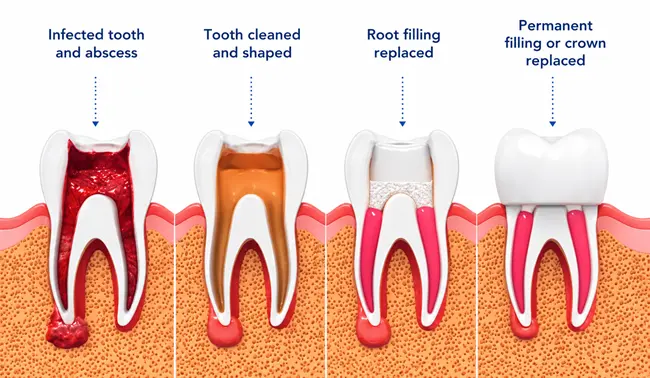
A natural tooth can be compromised primarily due to two major reasons — tooth decay or periodontal (gum) disease. When tooth decay is detected early, it can usually be treated with a simple filling. But if decay progresses deeper and reaches the pulp — the innermost part of your tooth containing the nerve and blood supply — a root canal becomes necessary.
Root Canal Treatment (RCT) is a specialised dental procedure performed to treat infection or inflammation of the pulp. The infected nerve tissue is carefully removed, the canals are thoroughly cleaned and disinfected, and the tooth is sealed with a biocompatible material called gutta-percha. The objective is to eliminate pain, remove infection and preserve your natural tooth.
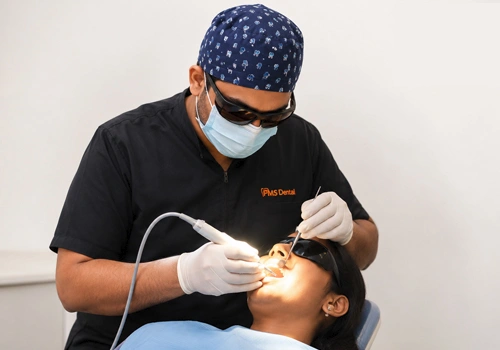
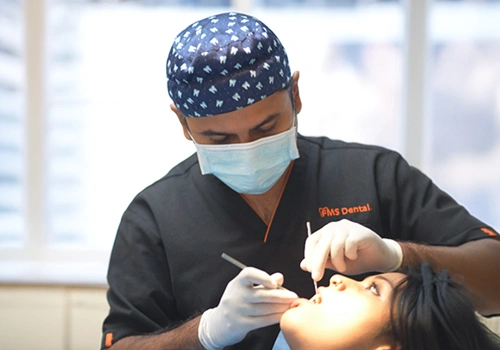
At FMS Dental, root canal treatments are performed by only specialist Endodontists — not general dentists. This distinction matters more than most people realise. The team is led by Dr. Sekhar, Dr. Priyendu and Dr. Ravi Chandra, highly respected specialists who handle both routine and complex endodontic cases.
"In our experience at FMS Dental, the number one reason patients delay root canal treatment is fear. And in over 30 years of practice, the most common thing patients say after the procedure is — 'That was nothing like I expected.' The pain from an untreated infection is always worse than a root canal. We promise you that."

Pain that throbs constantly, especially at night, or gets worse when you lie down — this is the infected nerve signalling distress.

If hot or cold food/drinks cause pain that lasts more than a few seconds after you've stopped consuming them, the pulp may be inflamed.

Sharp pain when you bite down or apply pressure to a specific tooth — especially if the pain is worsening over time.
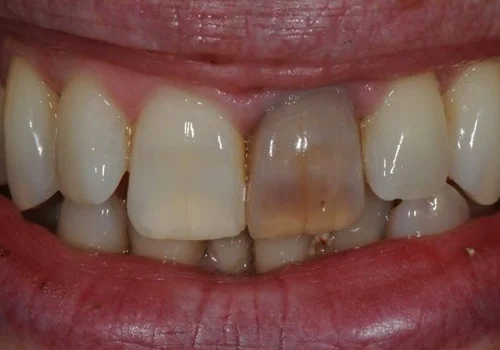
A tooth turning grey, brown or darker than its neighbours may indicate internal nerve damage or dead pulp tissue.
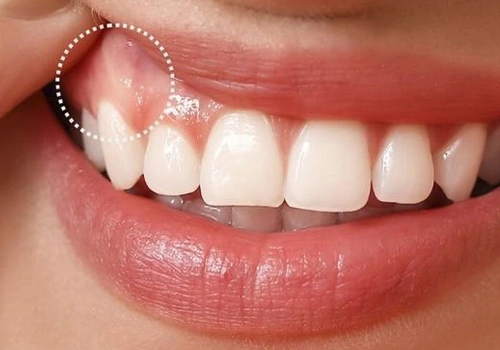
Swelling, tenderness or a raised bump (like a pimple) on the gum near the painful tooth is a sign of spreading infection.

If your tooth keeps hurting even after a course of antibiotics, the infection is inside the tooth — where antibiotics alone cannot reach.

Tooth pain that prevents sleep is a serious signal. The infected pulp has reached a point where conservative treatment is no longer sufficient.
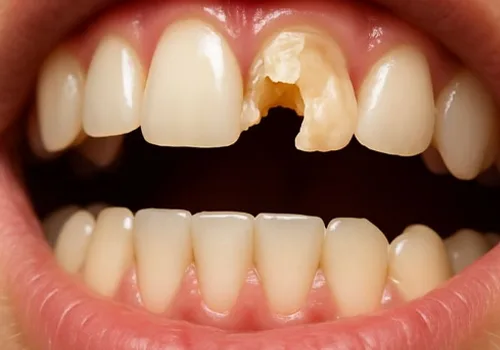
Physical damage to a tooth can allow bacteria to enter the pulp chamber. Even small cracks can lead to nerve infection over time.

Pain that comes on suddenly with no obvious trigger — eating, temperature or pressure — indicates the nerve may be dying.
Bone loss around the tooth root, visible on an X-ray, indicates a chronic infection that requires endodontic intervention to stop further damage.
Signs you need root canal treatment include: severe throbbing toothache, prolonged sensitivity to hot or cold, pain when biting, a darkened tooth, swelling near the tooth, and a pimple on the gum.
Other warning signs include spontaneous pain with no trigger, pain that keeps you awake at night, and a tooth that has previously been chipped or cracked. If infection is visible as bone loss on an X-ray, treatment is urgent. Do not ignore these signs — delayed treatment allows infection to spread into the jawbone.
Tooth pain that lasts more than 24 hours is a sign your nerve is in distress. The longer you wait, the more complex — and costly — treatment becomes. An infection that could be resolved with a single-sitting root canal today can progress to require surgery or extraction within weeks.
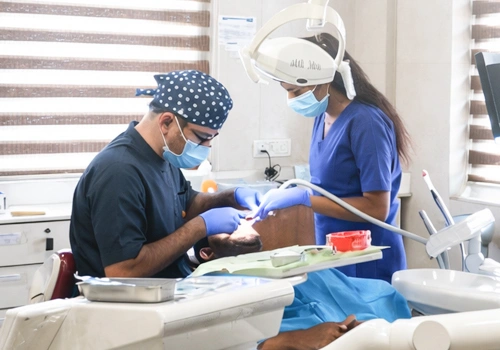
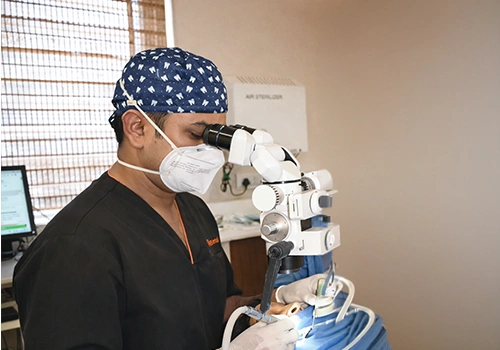
Microscopic root canal treatment uses a dental operating microscope to magnify the root canal system up to 25 times, enabling the endodontist to identify hidden canals, cracks and infected tissue invisible to the naked eye.
At FMS Dental Hyderabad, microscopic RCT delivers significantly higher success rates than standard root canal treatment — particularly for complex cases, curved root anatomy, calcified canals and retreatments. The procedure costs ₹13,000 onwards per tooth. It is performed by specialist endodontists Dr. Sekhar and Dr. Priyendu at FMS Dental clinics across Hyderabad.
Single sitting root canal treatment completes the entire RCT procedure — pulp removal, canal cleaning, disinfection and permanent sealing — in one appointment of approximately 60–90 minutes.
At FMS Dental Hyderabad, single-sitting RCT is recommended for appropriate cases where infection is controlled and root anatomy is suitable. It eliminates the need for temporary restorations and multiple clinic visits. Patients can return to normal activities the same day. Your endodontist will assess clinical suitability before recommending this approach.
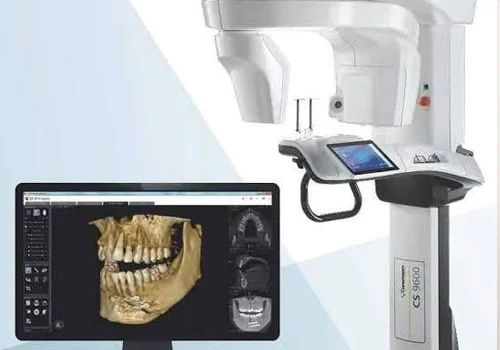
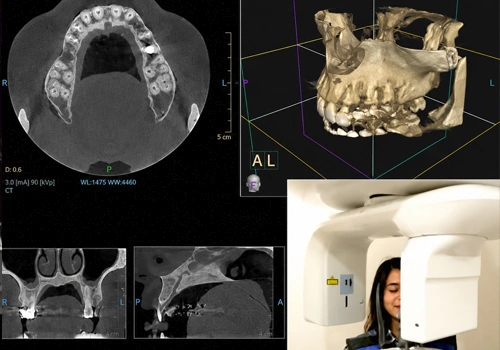
A detailed digital X-ray or CBCT 3D scan is taken to assess the full extent of infection, root canal anatomy, number of canals and bone involvement. This step gives your endodontist a complete picture before touching the tooth.

The area around your tooth is numbed completely with local anaesthesia. You may feel a slight pressure — but no pain. At FMS Dental, patient comfort is confirmed at every step before proceeding. If you feel anything at all, tell us — we'll adjust.
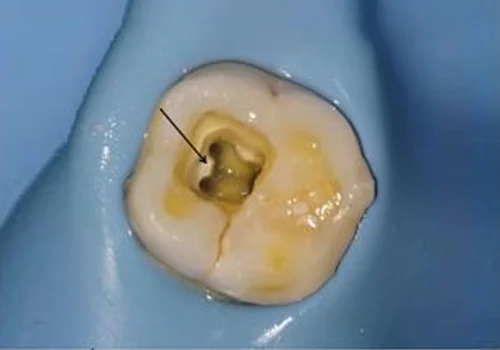
A small opening is made through the crown of the tooth to access the pulp chamber. You're fully numb at this point. This takes only a few minutes.
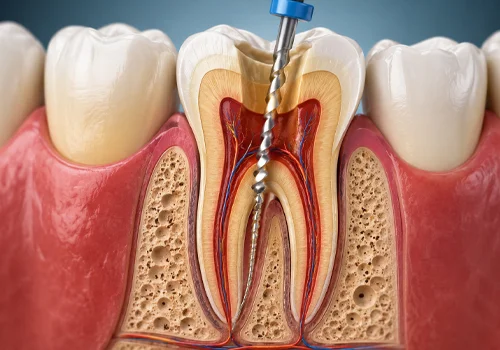
The infected pulp tissue is removed using precision endodontic files. ProTaper rotary instruments clean and shape the root canals to the correct size and taper, ensuring thorough irrigation can reach every part of the canal.
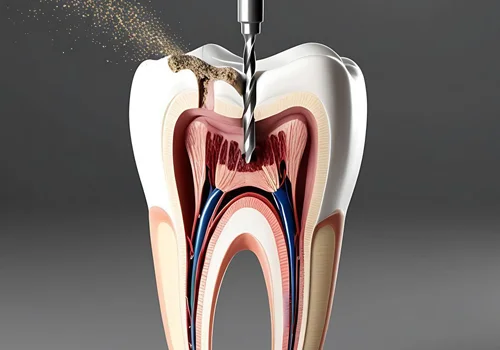
Irrigants including sodium hypochlorite and saline are used to flush the canals and eliminate remaining bacteria. In laser RCT cases, laser energy is applied at this stage for deeper disinfection.
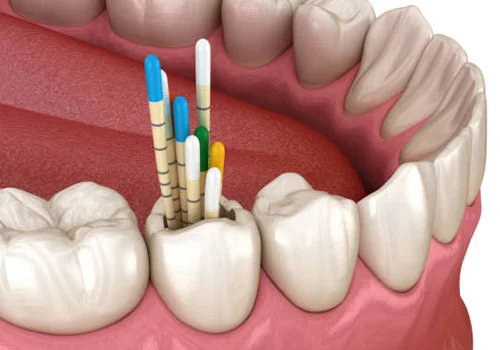
The cleaned canals are sealed with gutta-percha — a biocompatible, rubber-like material — and dental sealer. This prevents any future bacterial reentry into the treated root system.
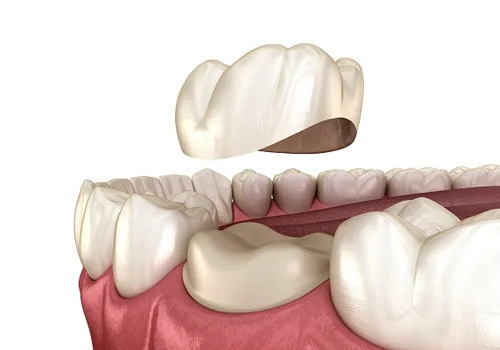
A post-RCT crown (typically zirconia) is placed to restore full strength and function to the tooth. This step is critical — a root canal treated tooth without a crown is vulnerable to fracture. Most patients schedule the crown within 1–2 weeks of completing RCT.
At FMS Dental Hyderabad, routine root canal treatment typically takes 1–2 sittings. Single-sitting RCT is available for suitable cases and completes the entire procedure in one appointment of 60–90 minutes.
Complex cases, retreatments or teeth with severe spreading infection may require 2–3 visits. Your endodontist will assess your clinical situation and recommend the most appropriate approach. All treatment is performed as a day-care procedure — patients can return to work and normal activities the same day.
Our endodontists are available 6 days a week at 12 clinics across Hyderabad — Jubilee Hills, Kondapur, Kukatpally, Secunderabad, Koti and more. Most patients are seen the same day or next day.
We know the words "root canal" probably made your stomach drop a little. That reaction is completely normal — and almost entirely based on outdated stories from 20–30 years ago, when anaesthesia and techniques were nothing like today.
Here's the truth in 2026: a root canal at FMS Dental feels like getting a routine filling. You're numb. You feel pressure, not pain. And when it's over, the throbbing that has been keeping you up at night — is gone.
Think about it this way. What hurts is the infection. The root canal ends the infection.
Advanced topical and local anaesthetic techniques ensure the tooth and surrounding area are completely numb before treatment begins. FMS endodontists use additional anaesthetic techniques for teeth with acute infection where standard numbing can be less effective — ensuring comfort throughout.
Microscopic magnification allows our endodontists to work with far greater precision — meaning less drilling, less disruption to surrounding tissue, and faster healing. The microscope makes the procedure more comfortable, not just more accurate.
Modern rotary instruments and experienced endodontists mean root canal treatment at FMS Dental is completed efficiently. Less time in the chair. Less fatigue. A day-care procedure — you return to work the same day in most cases.
No — root canal treatment at FMS Dental Hyderabad is not painful. It is performed under local anaesthesia by specialist endodontists, and most patients report the procedure feels similar to getting a filling.
Modern anaesthetic techniques ensure complete numbness throughout the procedure. Any mild sensitivity after treatment typically resolves within 24–48 hours. The pain you feel before RCT is from the infection — the treatment ends it. FMS endodontists use additional anaesthetic protocols for acute infection cases where standard numbing may be less effective.
| Treatment Type | Tooth Position | Cost Range | Typical Sittings |
|---|---|---|---|
| Standard Root Canal | Anterior (Front Teeth) | ₹5,500 onwards | 2–3 |
| Standard Root Canal | Premolar | ₹6,000 onwards | 2–3 |
| Standard Root Canal | Molar (Back Teeth) | ₹6,000 onwards | 2–3 |
| Microscopic Root Canal | Any Tooth | ₹13,000 onwards | 2–3 |
| Re-Root Canal Treatment | Any Tooth | ₹8,000 onwards | 2–3 |
| Post-RCT Crown (Zirconia) | Any Tooth | ₹10,000 – ₹14,000 | 1–2 |
Molar root canals are the most complex — molars have 3–4 canals compared to 1–2 for front teeth. More canals means more time and more precision required, which is reflected in the cost.
Microscopic RCT costs more than standard because of the specialist equipment and significantly increased precision involved. For complex cases, this technology investment substantially improves success rates.
Re-treatments, calcified canals, curved roots or prior instrument fractures require more time and specialist skill. CBCT imaging is used for complex cases, which ensures the procedure is done correctly the first time.
An endodontist is a root canal specialist with years of additional training beyond dentistry. Their in-depth knowledge of root anatomy, combined with advanced techniques, means complex and challenging cases are handled with greater precision and higher long-term success rates.
Badly decayed or broken-down teeth often need a post and core build-up after root canal treatment to restore the tooth structure before a crown can be placed. This additional procedure adds to the overall cost.
The type of crown placed after treatment significantly affects cost. PFM (porcelain-fused-to-metal) is the most affordable option; Zirconia offers superior strength and aesthetics at a mid-to-high price; e-max (lithium disilicate) is the premium choice for exceptional translucency and a natural look.
Root canal treatment at FMS Dental Hyderabad costs ₹5,500 onwards per tootth, and ₹13,000 for microscopic RCT.
These are the actual FMS Dental 2026 prices. Retreatment costs ₹7,500 onwards. A post-RCT zirconia crown costs ₹9,000–₹14,000. All costs are provided in a written itemised plan before treatment begins. Call +91 40 2222 1111 for a consultation at any of FMS Dental's 12 clinics across Hyderabad.
Experienced dental specialists delivering world-class care across all dental disciplines.
Root canal treatment saves the tooth — but the restoration brings it fully back to life. Heavily decayed or broken-down teeth may have very little natural structure remaining after treatment, making a simple filling insufficient. Our specialists assess each case and choose the right technique to rebuild the tooth from the inside out.
We use three proven post systems depending on the tooth's condition and the forces it must withstand:
Fiber posts flex with the tooth, reducing fracture risk — ideal for most front and premolar teeth. Metal posts offer maximum rigidity for high-load situations. Cast post & core is custom-fabricated in one piece for severely mutilated teeth with minimal remaining structure, providing an ideal foundation for a crown.
Instrument separation — where a tiny file breaks off inside a root canal during treatment — is a known complication in endodontics, particularly in narrow or curved canals. If left unaddressed, it can compromise the success of treatment. This is a highly specialised procedure that most general dental clinics are not equipped to handle.
Our endodontists use dedicated micro-surgical instruments and ultrasonic tips, working under magnification, to carefully bypass or retrieve broken instruments from the canal. Each case is assessed individually — in some situations, bypassing the fragment is the safest and most effective approach.
After root canal treatment, a After root canal treatment, a tooth loses its pulp — the living tissue that kept it nourished and resilient. Over time, this can make the tooth brittle and prone to cracking under biting forces, especially back teeth. A crown acts as a full-coverage shield, distributing load evenly and dramatically reducing the risk of fracture.
We believe in preserving as much of your natural tooth as possible. For suitable cases, we offer Endo Crowns — a more conservative alternative to traditional crowns that bonds directly to the remaining tooth structure using advanced adhesive technology. Less drilling. More of your natural tooth saved.
This section is specifically for patients who have recently completed root canal treatment and are wondering whether they really need a crown on top.
"One thing I tell every patient who needs a crown after root canal is this — don't wait. The root canal removes the nerve, yes. But it also removes the moisture supply to the tooth. Over time, that tooth becomes brittle — like dry wood compared to green wood. Even eating normally can crack it. I have seen perfectly well-done root canals fail — not because the RCT was wrong, but because the patient postponed the crown for too long. A crown is not optional after RCT. It is what makes the treatment work long-term."
The root canal treated tooth loses its moisture and becomes brittle over months
Normal chewing forces can split the tooth — sometimes to a point where it cannot be saved
A fractured root canal tooth may require extraction — losing both the RCT investment and the tooth itself
Without a crown, the temporary filling used after RCT can leak, allowing bacteria back into the treated canals
Most prosthodontists recommend crown placement within 1–2 weeks of completing root canal treatment
The longer you wait, the greater the brittleness risk
FMS Dental's 1–3 day in-house lab turnaround means you can often complete RCT and crown placement within the same week
A zirconia crown is the most common recommendation after molar RCT at FMS Dental
Don't delay your crown. Book your crown appointment at any FMS Dental clinic — our in-house lab ensures your crown is ready within 1–3 working days.
Book Crown AppointmentA root canal treated tooth without a crown is at very high risk of fracture — sometimes to an extent where the tooth cannot be saved and must be extracted.
Root canal treatment removes the nerve and blood supply, making the tooth brittle over time. Normal biting forces can split an unprotected root canal tooth. Crown placement within 1–2 weeks of completing RCT is strongly recommended at FMS Dental.
The in-house lab delivers permanent crowns in 1–3 working days — making it practical to complete both treatments in the same week.
This is the question many patients ask when they learn they have a severely infected tooth. The answer, in most cases, is straightforward: save the tooth if you can.
Your natural tooth — even after root canal treatment — is still the best thing in your mouth. Nothing replaces it perfectly. Not even a dental implant, as good as modern implants are.
| Factor | Root Canal Treatment | Tooth Extraction |
|---|---|---|
| Preserves Natural Tooth | ✅ Yes — tooth remains in jaw | ❌ No — tooth is permanently lost |
| Jawbone Preservation | ✅ Bone maintained normally | ⚠️ Bone resorption begins within months |
| Impact on Adjacent Teeth | ✅ None — teeth stay in position | ⚠️ Neighbouring teeth may shift or tilt |
| Immediate Cost | ₹5,500 onwards + crown | ₹2,500 onwards (extraction only) |
| Long-Term Cost | Lower — one-time procedure | Higher — implant/bridge needed later |
| Function | Full chewing function restored | Gap affects chewing until replaced |
| Aesthetics | Natural tooth appearance preserved | Visible gap or need for replacement |
| Procedure Invasiveness | Conservative — tooth preserved | Irreversible removal of natural tooth |
"When a tooth can be saved, save it. An extraction is always irreversible. Root canal treatment, with a good crown, gives that tooth decades more function. We only recommend extraction when the tooth is genuinely unsalvageable — and we'll always tell you honestly which situation you're in, before recommending any treatment."
Root canal treatment is almost always preferable to extraction when the tooth can be saved — your natural tooth preserves jawbone, prevents neighbouring teeth from shifting, and functions better than any replacement.
Extraction creates a gap requiring an implant or bridge at significantly greater cost and complexity. At FMS Dental, endodontists only recommend extraction when the tooth is genuinely unsalvageable. Most infected teeth that appear to need extraction can be successfully treated with root canal treatment — even complex retreatment cases.
Magnifies the root canal system up to 25x. Allows the endodontist to see hidden canals, micro-cracks and infected tissue that are completely invisible to the naked eye — the single biggest advancement in modern endodontics.
Cone Beam CT scanning provides a detailed 3D view of root anatomy, number of canals, canal curvature and bone infection before treatment begins. CBCT gives your endodontist information that a standard flat X-ray simply cannot provide.
Nickel-titanium rotary instruments clean and shape root canals with precision and flexibility — especially in curved or narrow canals that are difficult or impossible to negotiate with manual files.
Precisely measures the length of each root canal electronically — ensuring canals are treated to exactly the right length without over-instrumentation or under-treatment. Eliminates guesswork in determining working length.
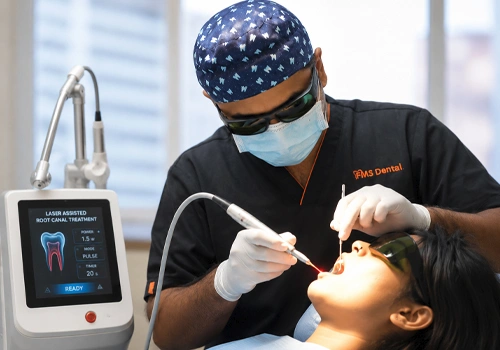
Dental laser energy penetrates and disinfects areas of the canal that conventional irrigation cannot reach — reducing bacterial load more thoroughly and improving long-term success rates, particularly in retreatment cases.
Digital X-rays deliver 90% less radiation than conventional X-rays, provide instant high-resolution images, and can be magnified on screen for more accurate interpretation of canal anatomy and infection extent.
Placing a crown within 1–2 weeks of completing root canal treatment is essential. A treated tooth without a crown is significantly weakened and prone to fracture — which can result in the tooth being unsalvageable. At FMS Dental, zirconia crowns restore full strength and natural appearance.
Learn About Zirconia CrownsA root canal treated tooth at FMS Dental, when protected with a crown, can last a lifetime or several decades — making it as permanent as any dental treatment can be.
Longevity depends on good oral hygiene, attending regular check-ups every six months, and ensuring the crown is placed promptly after treatment. Without a crown, a root canal treated tooth is at high risk of fracture. FMS endodontists' success rates are enhanced by specialist expertise, microscope magnification, CBCT diagnosis and precision-sealed canals.
Choosing the right clinic for root canal treatment is one of the most important decisions you'll make for your tooth. Root canal success depends on specialist expertise, accurate diagnosis and precise technique — not just on price.
At FMS Dental, root canal treatments are performed exclusively by specialist endodontists — Dr. Sekhar, Dr. Priyendu, Dr. Ravi Chandra and a team of trained endodontic experts. This is not the case at most dental clinics.
FMS International Dental Center is equipped with dental operating microscopes — allowing specialist-level endodontic care all over Hyderabad, not just at the flagship centre.
Every patient receives a written treatment plan with itemised costs before any procedure begins. You know exactly what you're committing to — no surprises at the billing counter.
FMS International Dental Center in Jubilee Hills is NABH accredited — India's highest standard for healthcare quality and patient safety — with strict sterilisation and clinical protocols at every branch.
Failed root canals from other clinics — including cases with broken instruments, persistent infections and failed apex surgeries — are a significant part of FMS Dental's endodontic workload. We manage what others cannot.
Root canal treatment available at Jubilee Hills, Kondapur, Kukatpally, Secunderabad, Koti, Dilsukhnagar, Kompally, Madinaguda, A S Rao Nagar, Langar House, Vanasthalipuram and Punjagutta.
FMS Dental (FMS International Dental Center) is widely regarded as the best clinic for root canal treatment in Hyderabad, rated #1 Dental Clinic in India by GCR with 50+ awards and NABH accreditation.
Root canal treatments at FMS are performed exclusively by specialist endodontists — Dr. Sekhar, Dr. Priyendu and Dr. Ravi Chandra — using dental microscopes, CBCT imaging, ProTaper rotary systems and laser disinfection.
With 12 clinics across Hyderabad and 4.9★ Google rating from 7,000+ reviews, FMS Dental is the most trusted endodontic centre in Telangana.
Specialist in microscopic root canal treatment and single-sitting RCT, Dr. Priyendu brings precision and patient comfort to every procedure. Known for clear communication and a gentle, anxiety-absent approach — particularly valued by patients who have postponed treatment due to fear.
View Profile
One of Hyderabad's most experienced endodontists, Dr. Sekhar leads complex root canal cases at FMS Dental including microscopic RCT, calcified canal management and re-treatment cases. His precision and patient-first approach have made him one of the most trusted specialists in the city.
View Profile
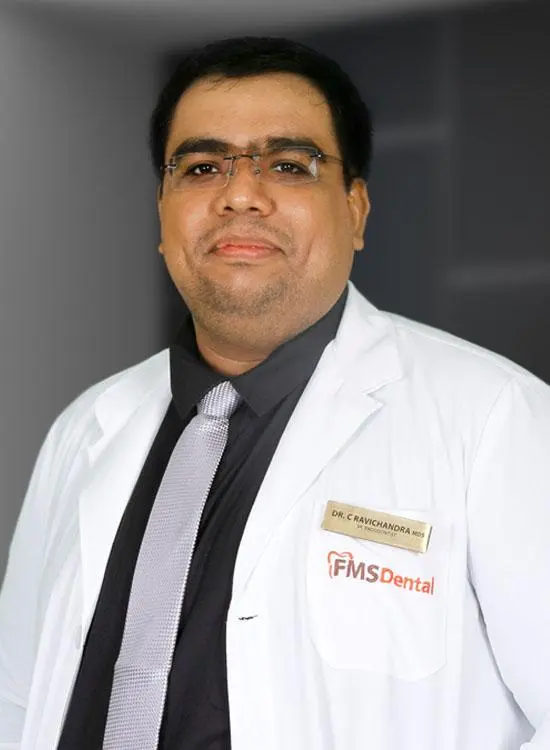
Dr. Ravi Chandra specialises in retreatment cases and complex endodontic conditions — including broken instrument retrieval, non-surgical apex management and re-RCT. His expertise makes FMS Dental the referral destination for failed root canal cases from across Hyderabad and India.
View Profile"I had been scared of getting a root canal for almost two years. Dr. Priyendu explained everything clearly before starting. The whole procedure was done in one sitting and I felt absolutely nothing."
"I went to two other clinics in Hyderabad who couldn't fix my root canal done elsewhere. Dr. Ravi Chandra used a microscope to find the issue. The level of expertise here is exceptional."
"My molar needed urgent root canal treatment and FMS saw me the same day. Dr. Sekhar was incredibly calm and reassuring. The pain disappeared immediately after treatment."
Yes — FMS Dental Kondapur on Gachibowli-Miyapur Road (opposite KIMS Hospital) has a dedicated endodontist available Monday to Saturday. It is one of our busiest clinics for root canal treatment in the Kondapur–Madhapur–Gachibowli area. Call +91 8886 643230 for an appointment.
Yes — all FMS Dental clinics are open on Sundays from 10:00 AM to 4:00 PM. If you have a dental emergency on a Sunday, call +91 40 2222 1111 and our team will guide you to the nearest available endodontist in Hyderabad.
FMS Dental Kukatpally serves patients from Kukatpally, KPHB Colony, Miyapur and surrounding areas. Located above SBI Bank, it is staffed by a trained endodontist. Call +91 8886 643228 for same-day or next-day appointments.
FMS International Dental Center in Jubilee Hills, near Daspalla Hotel on Road No. 37, is the NABH-accredited flagship clinic for complex endodontic cases — including microscopic RCT, retreatments, CBCT-guided procedures and broken instrument retrieval. Contact: +91 8885 060780.
FMS Dental Secunderabad, located behind Apollo Hospital, serves patients from Secunderabad, Trimulgherry, Bowenpally and surrounding areas. Call +91 8886 643225 to book a root canal appointment.

Root canal treatment removes infected or damaged pulp tissue from inside the tooth, cleans the root canals and seals them with biocompatible gutta-percha material. The objective is to eliminate pain, remove infection and preserve the natural tooth. At FMS Dental it is performed under local anaesthesia by specialist endodontists and is a day-care procedure — patients return to normal activity the same day.
No. Root canal treatment at FMS Dental is not painful. It is performed under local anaesthesia and most patients describe it as feeling similar to getting a filling. The procedure relieves the pain from infection — it does not create pain. Any mild sensitivity after treatment typically resolves within 24–48 hours.
Routine root canal treatment at FMS Dental typically takes 1–2 sittings. Single-sitting RCT is available for suitable cases and completes the entire procedure in one 60–90 minute appointment. Complex retreatments or severely infected teeth may require 2–3 visits. Your endodontist will recommend the most appropriate approach after examining your X-ray.
At FMS Dental Hyderabad: ₹5,500 onwards per tooth· microscopic RCT ₹13,000 onwards · retreatment ₹7,500 onwards. A post-RCT crown costs ₹9,000–₹14,000. Complete treatment plans with itemised costs are provided before any procedure begins.
Delaying treatment allows infection to spread from the tooth root into surrounding bone, causing an abscess, facial swelling and progressive bone loss. Once the infection spreads significantly, tooth extraction may become the only option. Tooth pain that lasts more than 24 hours warrants prompt assessment — early treatment is simpler, shorter and less expensive.
Microscopic root canal treatment uses a dental operating microscope to magnify the root canal system up to 25 times. This allows the endodontist to identify hidden canals, hairline cracks and infected tissue that are invisible without magnification. It delivers significantly higher success rates, particularly for complex anatomy, calcified canals and retreatment cases. Cost at FMS Dental: ₹4,000–₹12,000.
Yes, in most cases — especially for back teeth (molars and premolars). A root canal treated tooth loses moisture and becomes brittle over time, making it vulnerable to fracture. A crown restores full strength, function and appearance. At FMS Dental, zirconia crowns are recommended for their strength and natural aesthetics. Schedule your crown within 1–2 weeks of completing RCT.
Single sitting RCT completes the entire procedure — pulp removal, canal cleaning, disinfection and sealing — in one appointment of approximately 60–90 minutes. It is available for suitable cases at FMS Dental where infection is controlled and canal anatomy is straightforward. Your endodontist will assess suitability at your initial appointment.
Yes. A root canal treated tooth at FMS Dental, when protected with a good crown and maintained with regular check-ups, can last a lifetime or several decades. The key factors are: quality of the original RCT, prompt crown placement, good oral hygiene and regular professional cleaning every six months.
Yes. Root canal treatment is a safe, well-established dental procedure. At FMS Dental, it is performed by specialist endodontists using biocompatible materials (gutta-percha), under strict sterilisation protocols and local anaesthesia. CBCT imaging and dental microscopes reduce the risk of complications significantly. The procedure has an excellent safety and success record.
For the first 24–48 hours: eat soft foods — rice, dal, curd, bananas, soups, eggs — on the opposite side of your mouth. Avoid very hot, cold or hard foods. Do not chew on the treated tooth until your crown is placed.
Occasionally, root canal treatment may not fully heal due to missed canals, persistent infection or fracture. At FMS Dental, failure rates are minimised through CBCT-guided diagnosis, dental microscopes and specialist endodontist expertise. When initial treatment has not succeeded, retreatment (Re-RCT) can often save the tooth — FMS endodontists have significant experience in complex retreatment cases including broken instrument retrieval.
At FMS Dental, root canal treatments are performed exclusively by specialist endodontists — not general dentists. The team is led by Dr. Sekhar, Dr. Priyendu and Dr. Ravi Chandra, supported by a team of trained endodontic specialists across all 12 FMS Dental clinics in Hyderabad. This specialist-only approach is one of the key reasons for FMS Dental's high endodontic success rates.
Laser-assisted root canal treatment uses dental laser energy to enhance disinfection of the root canal system. The laser reaches areas of the canal that conventional irrigation may not fully penetrate, eliminating bacteria more thoroughly. At FMS Dental, laser RCT is used in combination with standard endodontic protocols for improved disinfection — particularly valuable in complex or retreatment cases. See Laser RCT at FMS Dental.
Root canal treatment saves the natural tooth by removing infection from inside it. Tooth extraction permanently removes the tooth. Saving the tooth with RCT is almost always preferable — it preserves jawbone density, prevents neighbouring teeth from shifting and eliminates the need for an implant or bridge. FMS endodontists only recommend extraction when the tooth is genuinely unsalvageable.
India's most awarded dental clinic for endodontics. Specialist endodontists only. 12 clinics in Hyderabad. NABH accredited. Same-day appointments available.