

FMS is awarded with 70+ Awards in 5 years. Rated #1 Dental Clinic in India by GCR (Global Clinic Rating)
+914022221111
When you lose a tooth, the jaw bone beneath it slowly starts to shrink away — just like how an unused muscle weakens over time. This bone loss doesn’t just affect your ability to get a dental implant; it also changes your facial shape, making your cheeks appear sunken and your smile aged.
A bone graft is a simple, safe and scientific way to rebuild this lost bone.
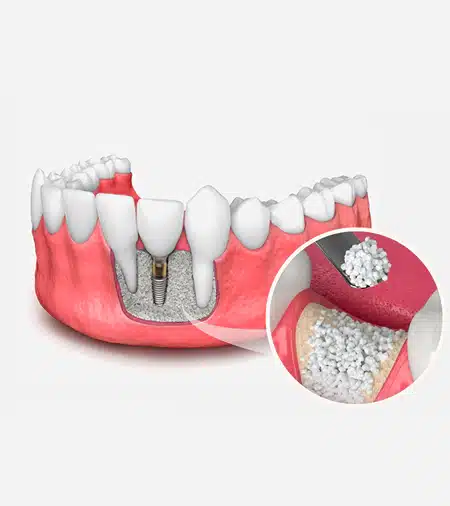
It involves placing a special bone material in the area where bone is missing. This graft acts as a scaffold, helping your body grow new, healthy bone in that area.
Once the bone becomes strong again, the implant dentist can place a dental implant that will hold your new tooth firmly — just like your natural teeth once did.
Bone grafting has become a routine part of modern implant dentistry, performed comfortably under local anaesthesia and with minimal recovery time. It not only makes implants possible but also helps preserve your natural facial contour and smile for the long term.
✅ In short: Bone grafting gives your jaw the strength it needs to hold your dental implants firmly — ensuring your new teeth look, feel and function naturally for decades.
A bone graft in dentistry is a procedure where a small quantity of bone or bone-like material is added to your jaw to rebuild lost bone.
Think of your jawbone as the foundation of your house — if part of it erodes, you can’t build a strong structure over it. A bone graft simply restores that missing foundation, allowing the Implantologist to place an implant securely later.
Over the next few months, your body naturally fuses with this graft, turning it into your own living bone — strong, healthy and capable of supporting an implant for life.
When a tooth is lost, the surrounding jawbone slowly shrinks or resorbs because it no longer has a root to support. Over time, this leads to insufficient bone volume — making it difficult to place a dental implant securely.
A dental implant is a small titanium or zirconium fixture designed to replace the missing tooth root. For this implant to integrate firmly with your jawbone — a process known as osseointegration — it must be surrounded by a healthy, adequate volume of bone.
When bone resorption occurs due to long-term tooth loss, these anatomical limitations can make implant placement risky or impossible without bone rebuilding.
👉 That’s where bone grafting comes in — it helps rebuild the lost bone, providing the necessary height and width for safe and successful implant placement.
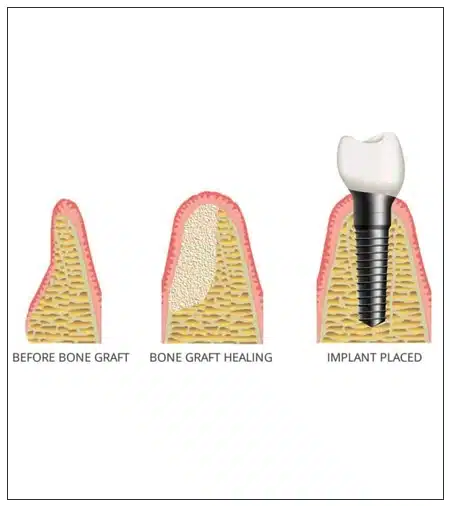
Modern bone grafting techniques are highly successful, with success rates above 90% when performed using proper materials and techniques. The key to success lies in choosing the right type of graft material suited to your clinical need.
The best type of bone graft is usually an autograft, which is bone taken from your own body — typically from the chin, jaw or sometimes the hip. Because it comes from you, it contains living bone cells and natural growth factors, allowing for faster healing and excellent integration. This procedure requires an additional surgical site to take the graft from your body.
When a patient’s own bone isn’t preferred, the next best options are processed donor bone from cadaver (allograft) or bone derived from animal sources (xenograft), both of which are completely safe, sterilized and clinically proven to stimulate new bone growth. In addition, synthetic bone graft materials, such as calcium phosphate or hydroxyapatite, are also widely used today. These materials are biocompatible, easy to handle and act as a scaffold for your body to naturally regenerate its own bone over time.
Various types of Bone Grafts are available to Rebuild Lost Bone:
Type | Source | Description | Typical Use |
Autograft | From your own body (chin, jaw, or hip) | Contains live bone cells, promotes quick healing | Large defects |
Allograft | Donor human bone (tissue bank) | Safe, sterilized and processed to remove proteins | Common for moderate bone loss |
Xenograft | Bone from animals (usually bovine) | Acts as a natural scaffold for new bone to grow | Widely used around implants |
Alloplast (Synthetic) | Man-made materials like calcium phosphate | Completely synthetic and biocompatible | Ideal for small grafts or socket preservation |
💡 Autografts are considered the best because they come from your own body — but modern allografts, xenografts and synthetic materials are equally predictable and safe for most cases.
FMS Dental utilizes clinically proven, biocompatible bone graft materials designed to promote natural bone regeneration. These grafts function as a supportive framework, enabling the body to gradually restore lost bone. FMS Dental sources high-quality bone graft materials from globally recognized brands such as Rocky Mountain and NovaBone (USA), as well as Cryos from Nobel Biocare, Sweden. In addition, cost-effective options like Bio-Oss from Switzerland are also incorporated to meet diverse patient needs.
There are several types of bone grafting procedures, depending on where and how much bone needs to be rebuilt.
🦷 1. Socket Preservation (Post-Extraction Grafting)
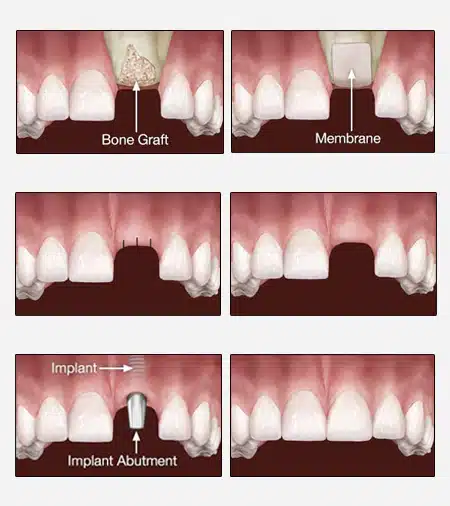
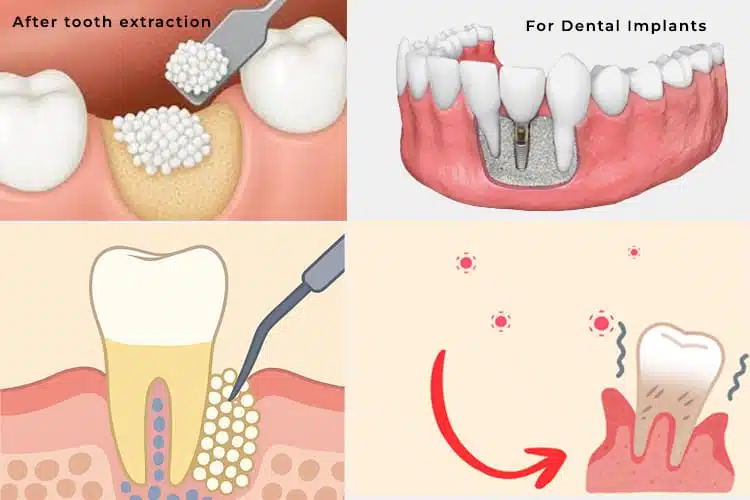
After a tooth extraction, the socket (the empty bone space) starts to shrink immediately.
To prevent this, the implant dentist places a bone graft material into the socket right after the tooth is removed.
A protective membrane is then placed over it to help healing and preserve bone volume.
This ensures that after 3–4 months, your bone is ready for implant placement.
🪶 2. Sinus Lift / Sinus Augmentation (Upper Jaw)
In the upper jaw, the back tooth area often has limited bone due to proximity to the maxillary sinus (air space).
When a tooth is lost, the sinus expands downward, reducing the available bone height.
A sinus lift procedure involves gently lifting the sinus membrane upward and filling the space with bone graft material, creating a new solid foundation for implants.
After 4–6 months of healing, the area is ready for implant placement.
🧩 3. Ridge Augmentation
If the bone ridge is too thin or narrow to hold an implant, ridge augmentation is performed.
This involves placing bone graft material along the thin ridge to widen it and restore proper bone dimensions.
🦴 4. Block Grafting (for Severe Bone Loss)
In advanced cases of bone loss, a small “block” of bone (autograft) may be taken from your jaw or chin and fixed to the deficient area.
This creates a stable, new bone structure to support future implants.
Not always — but in most cases, socket preservation immediately after extraction is highly recommended.
When a tooth is removed, the surrounding bone naturally starts to shrink.
Placing a bone graft immediately prevents that shrinkage, maintains your bone height and width, and makes future implant placement much simpler and predictable.
So yes, while it’s not mandatory in every case, grafting immediately after extraction is the smartest choice for long-term implant success.
Bone grafting isn’t just about enabling an implant — it’s about restoring your natural facial structure, preventing jaw shrinkage and giving your dental implant the strength to last for life.
Benefits of Bone Grafting include, “bone graft”:
✅ Provides a strong foundation for dental implants
✅ Prevents bone loss after tooth extraction
✅ Improves facial shape and symmetry
✅ Helps maintain a youthful appearance
✅ Ensures long-term stability and comfort of implants
✅ Boosts implant success rate (over 95%)
Imagine your jawbone as a garden bed and your implant as a plant.
If the soil has eroded, you need to add fresh soil before planting.
That’s exactly what a bone graft does — it restores the soil (bone) so your plant (implant) can take firm root and thrive beautifully.
At FMS International Dental Center, bone grafting is not just a procedure — it’s a carefully crafted process guided by over 30 years of clinical excellence in advanced implantology. FMS combines,
✅the expertise of senior implant specialists,
✅Bone Grafts done by senior Oral & Maxillofacial Surgeons
✅latest 3D imaging and regenerative technologies
✅OHSA standards of Sterilization protocols
✅NABH-accredited protocols,
to ensure precise, predictable and comfortable results.
Every bone graft is planned digitally, performed under sterile microsurgical conditions and supported by world-class biomaterials that promote faster healing and long-term success. Whether you need a simple graft or a complex sinus lift, you are in the safest hands — where science, experience and compassion come together to rebuild both bone and confidence.
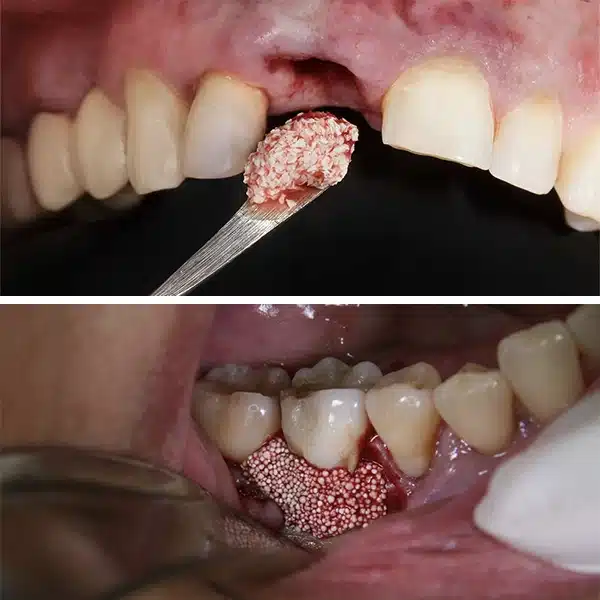
✅ Bone grafts are safe and common
✅ They rebuild missing bone for successful implants
✅ Healing takes 3–6 months
✅ Success rates exceed 90%
✅ The result — a strong, natural and lifelong smile!
🧭 Final Thoughts
A bone graft might sound complex, but in reality, it’s one of the most routine and rewarding parts of modern implant dentistry.
It helps your body regrow its own bone, setting the stage for a healthy, natural-looking and lifelong smile.
At FMS Dental, our implant specialists use advanced imaging, world-class graft materials and minimally invasive techniques to ensure maximum comfort, safety and success.
“Bone grafting doesn’t just rebuild bone — it rebuilds confidence, strength and the foundation of your smile.”
Dental health goes beyond just teeth. The strength and stability of your smile depend heavily…

When it comes to selecting the right clinic for a smile makeover…
Yes, advanced cosmetic dentistry softwares have revolutionized smile design and communication between…
Bone grafting a procedure to add or rebuild bone in your jaw before or during implant placement.
No. Bone grafting is done under local anaesthesia and post-op discomfort is minimal.
Many times, bone grafting is needed before implant treatment, because dental implants need sufficient bone for proper anchorage and stability.
Yes, if your bone is strong enough bone grafting is not needed to place the implant.
Bone grafting materials can be Autografts (from your body), Allografts (a human donor), Xenografts (an animal source), or Alloplasts (synthetic).
Yes, donor (Allografts) or animal (Xenografts) bone graft materials are completely safe. These materials are sterilized, biocompatible and approved for dental use.
Bone grafts usually take between 3 and 6 months for healing and bone formation.
Yes, in cases of mild bone loss, both bone grafting and implant placement can be done together.
Yes, you may actually look better — because the bone supports your facial shape.
If bone grafting is not done in low/minimal bone cases, the implant may not have enough support, leading to failure.
Yes, it’s a very safe and routine procedure even for older patients.
Bone grafts fail rarely. With proper care, success rates exceed 95%.
Cost of a bone graft depends on the material used and the extent, but it’s generally affordable and worthwhile. The cost of bone graft at FMS International Dental Center starts from Rs. 8,000/- onwards.
Sometimes — especially for large bone defects. But most bone grafts used are synthetic or donor material.
There are no side effects from using bone grafts as such. Mild swelling, tenderness may occur which are all short-term.
Yes, but healing is slower; quitting smoking improves success rates.
Avoid disturbing the site, keep it clean, and follow your dentist’s instructions.
Absolutely, bone grafts are also done in the upper jaw. Usually in the back tooth region of the upper jaw, in cases of missing teeth, the sinus cavity expands downward after tooth loss. Bone graft is done by pushing the sinus upward, called — sinus lift.
Usually not. Once the bone graft integrates, the bone becomes permanent and grafting again is not needed.
100%. Bone grafting ensures a strong, lasting foundation for your implant and your smile