
Why Our In-House Laboratory Makes the Difference
When patients ask us what really separates a veneer that looks obviously “fake” from one that looks like their own natural tooth, the answer almost always comes back to the same place: the lab, and the hands that built it.
At FMS Dental, our in-house laboratory, established in 1995, and master technicians, work side by side with our cosmetic dentists on every single case, not over email, not through a courier, but in the same building, often at the same chairside. Senior cosmetic dentist Dr. P. Parthasaradhi Reddy personally works alongside technicians on veneer cases, and his own deep expertise in advanced dental technology and materials means the collaboration goes both ways: the dentist isn’t simply handing off a prescription, but actively guiding material selection and design alongside the technician.
That proximity, combined with over 25 years of collaborative experience between master technicians and Dr. Reddy, is what allows us to consistently deliver veneers that mimic natural enamel rather than simply cover it up.
Here’s what actually goes into making a porcelain veneer look real, and why doing it in-house changes the outcome.
The Real Difference: Magnification and Detail Work
Natural teeth are not one flat colour. Enamel has depth, translucency, subtle white or brown flecks, faint craze lines, and a gradient of colour from the gumline to the biting edge. Reproducing all of that by hand requires seeing detail the naked eye simply cannot catch.
At FMS Dental, our master technician, works under magnification ranging from 3.5x to as high as 15x, layering porcelain and refining surface texture at a level of precision that’s impossible to achieve with the unaided eye. At this magnification, he can:
- Place internal characterizations exactly where they occur naturally in the patient’s remaining teeth
- Blend colour transitions so there’s no visible line between layers
- Sculpt micro-texture on the surface (perikymata, subtle ridges) that catches light the way real enamel does
This is the same level of precision jewellers and micro-surgeons use, and it’s a big part of why hand-layered veneers from a skilled technician look different from a stock, mass-produced shade.
Why Fabricating Veneers Is Harder Than Crowns
It surprises a lot of patients to learn that a full crown is, in many ways, an easier restoration to make than a veneer.
A crown is typically trimmed down with 1-2 mm of clearance all around, giving the technician room to build strength and layer material without worrying too much about the underlying tooth showing through or the margins being fragile.
A veneer, by contrast, works with just 0.3-0.5 mm of thickness, sometimes less, in ultra-conservative “no-prep” cases. Within that razor-thin space, the technician still has to:
- Build in enough layered depth to look natural
- Mask (or intentionally allow) the shade of the underlying tooth to show through correctly
- Maintain enough structural strength that the veneer won’t fracture at try-in or over the years
- Keep margins fine enough to be invisible at the gumline
There’s almost no room for error. It takes real expertise and years of hands-on skill to fabricate something this thin that is simultaneously durable, precisely fitting, and aesthetically layered. This is where an experienced master technician, not a junior lab tech running a mill, earns their reputation.
What Goes Into a Natural-Looking Veneer
Getting a veneer to disappear into a smile is a layered process, both literally and figuratively. Our technician builds each veneer with the following in mind:
Opaque dentine layer
The foundation layer that blocks out any discolouration from the underlying natural tooth and establishes the base value (lightness/darkness) the rest of the restoration is built on.
Translucency
Real enamel isn’t solid in colour; it becomes more translucent toward the incisal (biting) edge. This is recreated using specialised translucent porcelains layered thin at the edges, allowing light to pass through the way it does in a natural tooth.
Characterization
Fine details like mamelons, subtle white spots, faint staining, or craze lines are added by hand based on what’s happening in the patient’s adjacent natural teeth, so the veneer doesn’t look “too perfect.”
Halo effect
A soft, glowing translucent band near the incisal edge that’s a hallmark of youthful, natural enamel, one of the harder effects to fabricate convincingly, and something that really only comes through skilled hand-layering.
Colour transition, cervical to incisal
A natural tooth is rarely one uniform shade. There’s typically a warmer, slightly more opaque tone near the gumline (cervical third) that gradually shifts to a cooler, more translucent tone at the edge (incisal third). Recreating this gradient, not just matching a single shade tab, is what makes a veneer read as “real tooth” rather than “porcelain.”
Every one of these elements is judgment-based. It relies on the technician actually understanding cosmetic dentistry, not just following a prescription sheet.
25 Years of Collaboration
Technical skill on its own isn’t enough; it has to be paired with a deep working relationship with the cosmetic dentist planning the case. At FMS Dental, master technicians Javeed, Waseem, and many others have worked alongside senior cosmetic dentist Dr. P. Parthasaradhi Reddy and team for over 25 years, refining a shared visual language for shade, shape, and characterization.
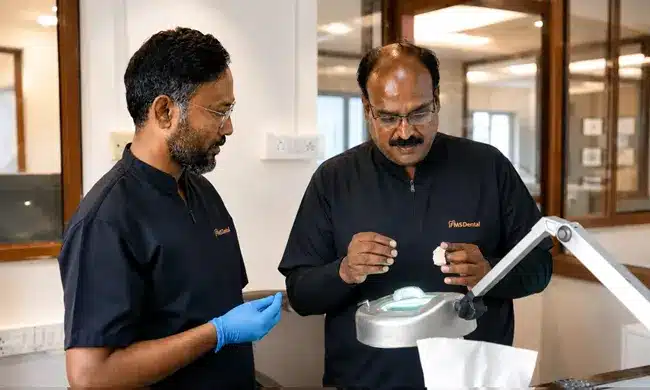
Dr. Reddy isn’t a dentist who simply sends off a prescription and waits for a finished restoration. He works directly with technicians through the design and try-in process, and his own command of advanced dental technology and materials means decisions on shade, material choice (feldspathic vs. Empress vs. e.max), and layering approach are made collaboratively, case by case, rather than left entirely to the lab.
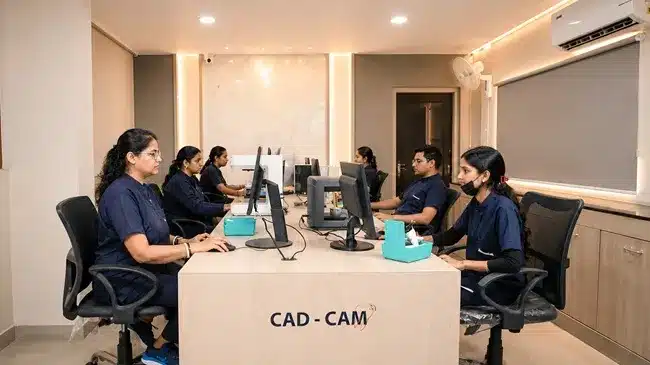
That kind of long-term collaboration means:
Technicians understands Dr. Reddy’s aesthetic preferences and case philosophy without needing lengthy written instructions
Chairside shade-taking and try-ins can be adjusted and corrected in real time, with both dentist and technician present
Feedback from 25 years of cases, what worked, what didn’t, how a certain patient’s teeth aged, feeds directly back into how future veneers are designed
This is something a remote, outsourced lab simply cannot replicate. Photos and shade tabs are a poor substitute for a technician and dentist who can look at the tooth together, under natural light, and adjust the build accordingly.
Step – by – Step process of Dental Veneers at FMS Dental
Broadly, veneer fabrication follows these stages:
Digital or conventional impression
A scan or physical impression captures the prepared tooth and surrounding dentition.
Design (CAD wax-up)
The restoration is designed digitally, mapping out shape, contour, and proportions relative to the adjacent teeth and smile line.
Fabrication
Depending on the material and case, this happens via milling, pressing, or a combination of both (detailed below).
Layering and characterization
For hand-layered cases, the technician builds up porcelain in stages, opaque dentine, body, translucent incisal layers, firing between stages in the porcelain oven.
Staining and finishing
Surface stains are applied for characterization (white spots, craze lines, subtle discolouration), followed by a final glaze firing and hand-polishing to get the correct surface texture and gloss.
Try-in and adjustment
The veneer is tried in the mouth, checked under different lighting, and adjustments are made before final cementation.
What materials do we use for dental veneers at FMS Dental
Not every case calls for the same material, and having an in-house lab means we can match the material to the case rather than being limited to whatever one outside lab offers:
Feldspathic porcelain
Hand-layered from scratch on a refractory die, offering the highest level of natural translucency and characterization. This is the gold standard for ultra-thin, highly aesthetic anterior veneers, though it demands the most technician skill.
Empress (pressed ceramic)
A glass-ceramic that’s pressed into shape, offering excellent strength and a good balance of aesthetics and durability, often layered or stained for characterization.
Milled e.max (lithium disilicate)
Digitally designed and milled for precision and consistency, then hand-characterized with stains and glaze. Strong, predictable, and efficient for cases needing tight tolerances.
CAD wax-up to press or mill workflow
Many cases start as a digital design (CAD wax-up) that’s then either milled directly or used to create a pattern for pressing, combining digital precision with the option of hand-finishing for aesthetics.
Veneer Expertise, Precision & Turnaround
How Fast Can Veneers Be Delivered at FMS Dental?
Because our lab is on-site, turnaround is significantly faster than sending cases to an external lab. In most cases, veneers can be designed, fabricated, characterized, and ready for try-in within 3 to 4 days. Depending on the number of veneers, complexity, and level of characterization required, in-house fabrication also allows for faster revisions if any adjustment is needed after try-in, without the delays of shipping models or restorations back and forth to an outside lab. Your dentist will give you a case-specific timeline, but the in-house workflow removes the biggest bottleneck most patients experience elsewhere: waiting on the lab.
On-site laboratory collaboration can reduce external-lab shipping delays and make revisions more efficient when adjustments are required after try-in.
Does FMS Dental have expertise in making dental porcelain veneers?
Given the above, our honest answer is: this is exactly the kind of setup you want for veneers. The two things that most reliably predict a natural-looking result are:
A technician with genuine artistic and technical skill, working under proper magnification, who understands layering, translucency, and characterization, not just shade-matching from a chart.
A tight, long-standing collaborative relationship between that technician and the cosmetic dentist planning the case.
FMS Dental has both: an in-house lab established in 1995, master technicians, with decades of hands-on experience and magnification tools up to 15x, working directly alongside senior cosmetic dentist Dr. P. Parthasaradhi Reddy, whose own expertise in advanced technology and materials shapes every case. Together, over 25 years, they offer a full range of materials (feldspathic, Empress, milled e.max, and CAD-integrated workflows) to match the right approach to each patient’s smile, with veneers typically ready in just 3 to 4 days.
Veneers are unforgiving of shortcuts. At 0.3-0.5 mm of material, there’s no room for guesswork, only precision, experience, and genuine artistry.
Veneer fabrication combines material science, digital planning, magnification, hand-finishing, shade control and close dentist-technician collaboration. The thinner the restoration, the less room there is for error.
Frequently Asked Questions
Clear answers about veneer fabrication, materials, precision, dentist-technician collaboration, turnaround time, and what goes into creating natural-looking porcelain veneers at FMS Dental.
An in-house lab allows the dentist and technician to communicate directly and make adjustments in real time. At FMS Dental, the technician and cosmetic dentist can assess the veneer’s shade, translucency, shape, and surface details together, including under natural light, rather than relying solely on photographs and written instructions sent to an external laboratory. This close collaboration helps create veneers that are designed to blend naturally with the patient’s existing teeth.
Veneers at FMS Dental are fabricated by master technicians at the clinic’s in-house laboratory, which was established in 1995. The technical team has worked alongside senior cosmetic dentist Dr. P. Parthasaradhi Reddy for more than 25 years, developing a shared approach to shade, shape, layering, and characterization.
Because the laboratory is located on-site, most veneers can be designed, fabricated, characterized, and made ready for try-in within 3 to 4 days. The exact timeline depends on the number of veneers, the complexity of the case, and the level of characterization required.
Depending on the case, FMS Dental uses feldspathic porcelain, pressed ceramic such as Empress, and milled e.max (lithium disilicate). A CAD wax-up may also be incorporated into the workflow. Having multiple material options in-house allows the dentist and technician to select an approach based on the patient’s tooth shade, aesthetic goals, and clinical requirements.
The dentist and technician work closely throughout the veneer design and try-in process. Dr. P. Parthasaradhi Reddy works directly with the technical team, helping guide decisions about shade, material selection, layering, shape, and characterization rather than simply sending a prescription to an outside laboratory.
Natural-looking veneers require more than simply matching a shade. The technician has to recreate details such as translucency, colour gradients, subtle characterization, surface texture, and the halo effect near the incisal edge. At FMS Dental, these details are refined under magnification ranging from 3.5x to 15x, helping the technician reproduce the depth and texture seen in natural enamel.
Veneers are extremely thin compared with full crowns. While a crown typically has around 1–2 mm of clearance, veneers may be only 0.3–0.5 mm thick. Within this limited space, the technician still needs to create sufficient strength, translucency, layering, and an accurate fit while keeping the margins highly refined.
During the try-in, the veneers are assessed in the mouth and checked for factors such as fit, appearance, and aesthetics. Because the FMS Dental laboratory is on-site, the dentist can communicate directly with the technician and revisions can be handled more efficiently, without the delays associated with sending the restoration back and forth to an external laboratory.
Natural-looking veneers are created through the combination of technical skill, material selection, magnification, careful characterization, and close dentist-technician collaboration.